

Choosing a WordPress plugin used to be relatively simple. You would search for a feature, install a plugin, activate it, and move on.
Today, it is not quite that easy.
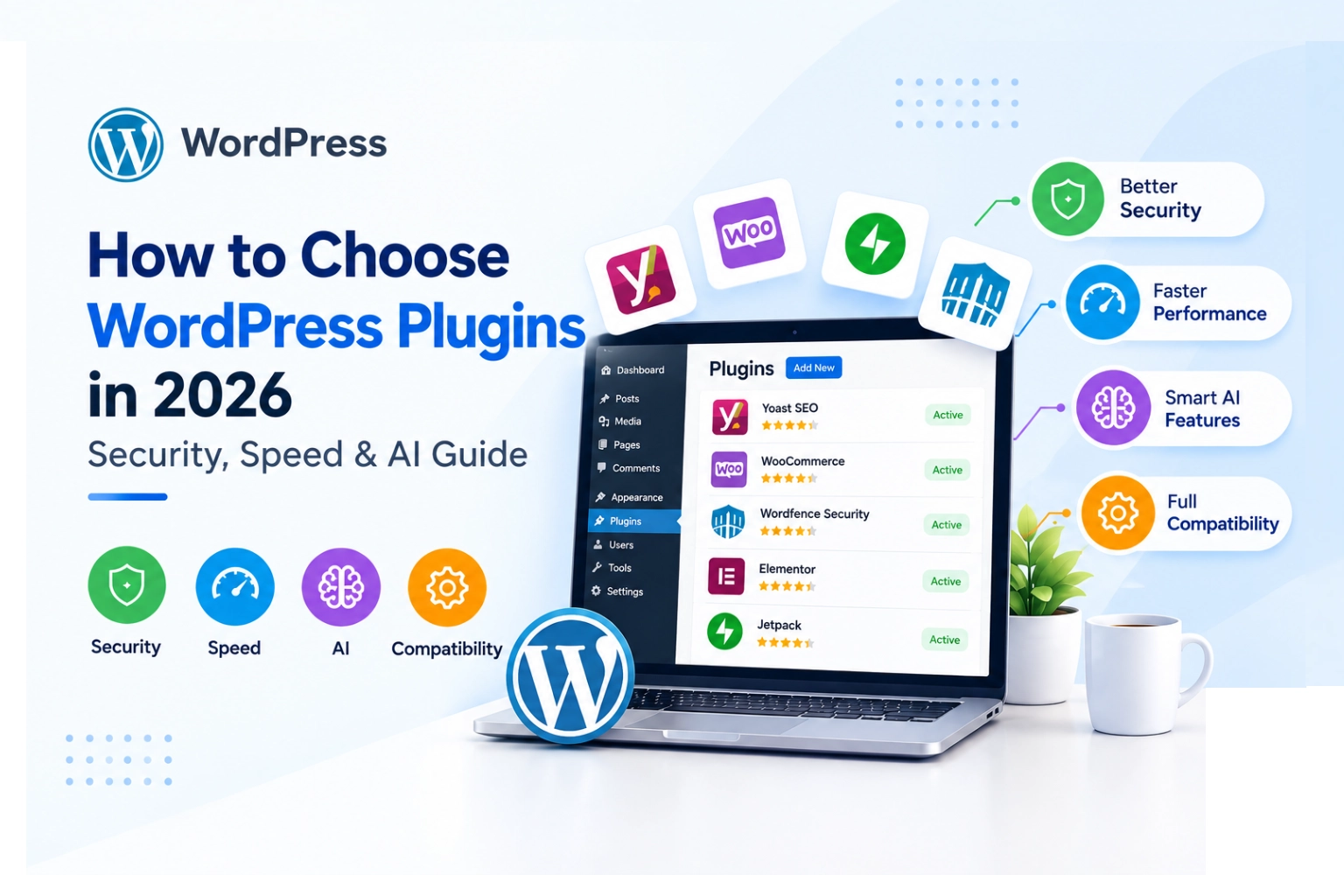
WordPress websites can use plugins for almost everything—from SEO and contact forms to ecommerce, security, analytics, performance optimization, automation, and artificial intelligence. But installing too many plugins or choosing poorly maintained ones can create security, compatibility, and performance problems.
This is becoming even more important as WordPress continues to evolve. WordPress 7.1.1, released in September 2026, included 11 security fixes, while recent WordPress releases have continued to introduce AI-related capabilities.
So, how do you choose WordPress plugins that are useful without putting your website at unnecessary risk?
Let’s look at the factors that actually matter.
Why Choosing the Right WordPress Plugin Matters
Plugins extend the functionality of WordPress without requiring you to build every feature from scratch.
For example, you might use plugins for:
- SEO optimization
- Contact forms
- Website security
- Caching and performance
- WooCommerce
- Backups
- Analytics
- Image optimization
- Email marketing
- AI-powered features
- Membership functionality
- Custom integrations
The problem is not necessarily the number of plugins.
The real issue is whether each plugin is necessary, trustworthy, compatible, and properly maintained.
A poorly maintained plugin can introduce security vulnerabilities, compatibility conflicts, unnecessary database activity, or additional scripts that affect website performance.
Recent security incidents involving WordPress plugins demonstrate why plugin maintenance should be taken seriously.
1. Start With the Feature You Actually Need
Before searching for a plugin, define the problem you are trying to solve.
For example, don’t search for:
“Best WordPress plugins”
Instead, identify the specific requirement:
“I need a plugin to create a custom product quote form.”
This approach helps you avoid installing several plugins that perform overlapping functions.
Ask yourself:
- What feature do I need?
- Can WordPress already do this without a plugin?
- Does my existing theme or plugin already provide this functionality?
- Will I need this feature long-term?
- Does the plugin need access to sensitive website data?
A smaller, carefully selected plugin stack is usually easier to maintain than a website filled with plugins that are rarely used.
2. Check When the Plugin Was Last Updated
One of the first things to check is the plugin’s update history.
A plugin that has not been updated for a long period may indicate that the developer is no longer actively maintaining it.
This does not automatically mean that an older plugin is unsafe. However, it should encourage you to investigate further.
Look for:
- Recent updates
- Compatibility with your WordPress version
- Recent support activity
- Changelog information
- Security fixes
- Active development
You should also keep WordPress itself updated. WordPress 7.1.1 is a recent example of why this matters: the release included both maintenance improvements and security fixes.
3. Don’t Choose a Plugin Only Because It Has a High Rating
Ratings can be useful, but they should not be your only deciding factor.
A plugin with thousands of positive reviews may still have compatibility issues with your particular website.
Look at the bigger picture:
Plugin reputation + maintenance + compatibility + functionality + security
For example, check whether users are reporting:
- Plugin conflicts
- Broken layouts
- Checkout problems
- PHP errors
- Compatibility issues
- Slow performance
- Poor developer support
Recent reviews can sometimes tell you more about the current state of a plugin than its overall rating.
4. Pay Attention to Plugin Security
Security should be one of your biggest considerations when installing a WordPress plugin.
A plugin can interact with your database, files, users, forms, payment systems, or administrator functionality depending on its purpose.
Before installing one, consider:
- Is the developer reputable?
- Is the plugin actively maintained?
- Does it receive security updates?
- Does it require unnecessary permissions?
- Are vulnerabilities being reported and fixed?
- Is the plugin downloaded from a trustworthy source?
This is especially important for ecommerce websites, membership websites, and websites that handle customer information.
WordPress itself has continued releasing security updates throughout 2026, reinforcing the importance of keeping the complete WordPress environment—not just WordPress core—maintained.
5. Think About Website Speed Before Installing a Plugin
Every plugin does not necessarily slow down a website dramatically.
However, plugins can add PHP processing, database queries, JavaScript, CSS, API requests, scheduled tasks, or other functionality.
Some plugins may load assets on every page even when their functionality is only required on one specific page.
Before installing a plugin, ask:
Does this plugin need to run everywhere on my website?
Performance becomes particularly important for:
- Ecommerce stores
- High-traffic websites
- Mobile users
- Content-heavy websites
- Websites relying heavily on page builders
Your existing WordPress PageSpeed guide can provide additional information about improving WordPress performance.
6. Avoid Installing Multiple Plugins for the Same Job
Plugin duplication is a common problem.
For example, a website might have:
- Two caching plugins
- Multiple image optimization plugins
- Two SEO plugins
- Several security plugins
- Multiple database optimization tools
More does not necessarily mean better.
In some cases, two plugins attempting to perform the same task can create conflicts.
Before installing a new plugin, check whether an existing plugin already provides the feature you need.
7. AI Plugins Are Becoming More Important in WordPress
AI is becoming a significant part of the WordPress ecosystem.
WordPress 7.0 introduced an AI Client and Abilities API designed to help WordPress communicate with generative AI models and enable new AI-powered workflows.
AI-related WordPress plugins can now help with tasks such as:
- Generating content ideas
- Creating summaries
- Suggesting titles
- Generating alt text
- Automating repetitive tasks
- Building AI chat experiences
- Connecting external AI services
- Working with website content
The official WordPress AI plugin, for example, has introduced features including bulk AI summaries and additional AI capabilities.
But AI functionality introduces another question:
What information does the plugin send to an external AI service?
Before installing an AI plugin, check:
- What data leaves your website?
- Which AI provider does it use?
- Is an API key required?
- Where are API credentials stored?
- What user data is processed?
- Can the feature be disabled?
AI can be useful, but it should be implemented with the same attention to security and privacy as any other third-party integration.
8. Check Plugin Compatibility Before Updating WordPress
WordPress updates are important, but major updates can sometimes expose compatibility problems with older plugins or themes.
Before performing a major update:
- Create a complete backup.
- Check plugin compatibility.
- Review recent plugin updates.
- Test important functionality.
- Check forms, checkout, login, and other critical areas.
- Test the website after updating.
For business and ecommerce websites, testing on a staging environment can significantly reduce the risk of unexpected problems.
9. Remove Plugins You Don’t Use
Deactivating an unnecessary plugin is not always the end of the story.
If you are certain that you no longer need a plugin, consider removing it completely after confirming that it does not store data that you need to retain.
A regular plugin audit can help you identify:
- Unused plugins
- Duplicate functionality
- Abandoned plugins
- Plugins causing errors
- Plugins affecting performance
- Plugins that are no longer necessary
Think of your WordPress plugins like applications on your computer: if you don’t need something anymore, keeping it installed indefinitely may not provide any benefit.
10. Create a Simple WordPress Plugin Checklist
Before installing a new plugin, use this checklist:
WordPress Plugin Checklist
Functionality
- Does it solve a specific problem?
- Do I actually need it?
Security
- Is it actively maintained?
- Does the developer release security fixes?
- Does it come from a trustworthy source?
Compatibility
- Is it compatible with my WordPress version?
- Does it work with my theme?
- Does it conflict with another plugin?
Performance
- Does it load unnecessary resources?
- Does it add database queries or background processes?
- Does it affect Core Web Vitals?
Support
- Is there recent support activity?
- Are reported bugs being addressed?
AI and third-party services
- Does it send data outside my website?
- Does it require an API key?
- What information does the external service receive?
If you cannot answer these questions, investigate the plugin before installing it on a production website.
How Many WordPress Plugins Should a Website Have?
There is no universal number of plugins that every WordPress website should have.
A website with 15 well-maintained plugins can have more problems than another website with 30 carefully selected plugins.
The better question is:
Does every installed plugin provide useful functionality without creating unnecessary security, performance, or compatibility risks?
Focus on quality rather than simply counting plugins.
When Should You Replace a WordPress Plugin?
Consider replacing a plugin when:
- It has not been maintained for a long time.
- It is causing recurring errors.
- It conflicts with important plugins.
- It negatively affects performance.
- The developer no longer supports it.
- A better-maintained alternative is available.
- It provides functionality you no longer need.
- Security concerns cannot be adequately addressed.
Before replacing a plugin, create a backup and test the replacement on a staging website whenever possible.
Final Thoughts
WordPress plugins make it possible to build powerful websites without developing every feature from scratch. But convenience should not mean installing every plugin that looks useful.
The best approach is to choose plugins based on functionality, security, maintenance, compatibility, performance, and long-term value.
In 2026, there is another factor to consider: AI. As AI becomes more deeply integrated with WordPress, website owners should look beyond the feature list and understand how an AI plugin handles data, API credentials, external services, and website content.
A good WordPress website does not need dozens of plugins simply because they are available. It needs the right plugins, properly configured and regularly maintained.
If your WordPress website is experiencing plugin conflicts, performance problems, compatibility errors, or security concerns, a professional WordPress audit can help identify the underlying issues before they become larger problems.