

The way people find information online has fundamentally changed. Not gradually dramatically. When Google rolled out AI Overviews (formerly known as Search Generative Experience or SGE) to all U.S. users in May 2024, it marked the most significant shift in search behavior since the introduction of featured snippets. Brands, publishers, and businesses that once relied solely on blue-link rankings are now asking a new and urgent question: how to appear in AI Overviews and stay visible in this AI-first era.
Whether you are a digital marketer, a business owner, or a technical agency like My DevIT Solutions helping clients navigate the evolving search landscape, this guide explains AI Overviews and reveals the precise on-page and off-page tactics that can help Google cite your content.
What Are AI Overviews?
Before we discuss how to get featured in AI Overviews, you must understand what they are and why they matter.
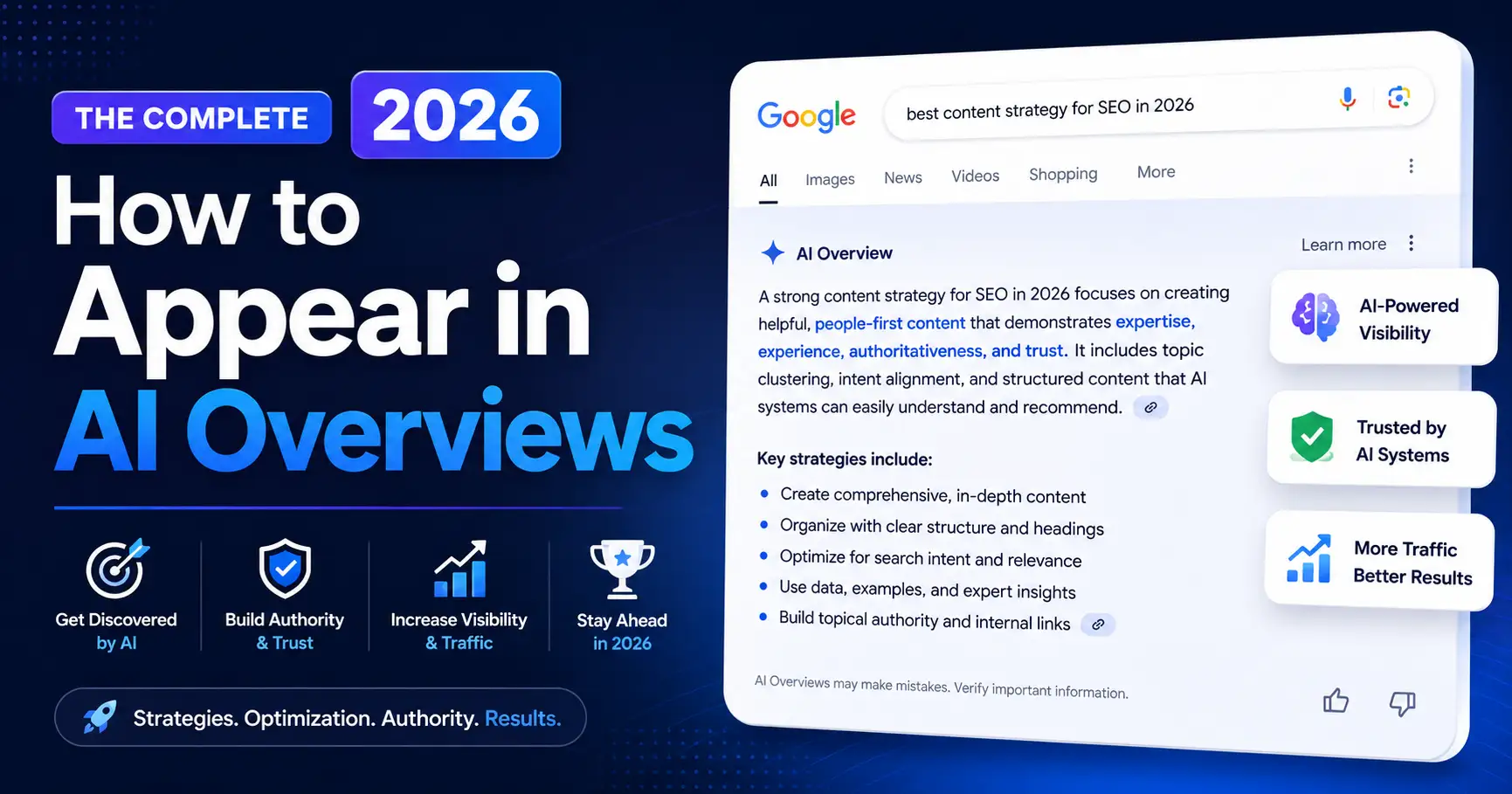
AI Overviews are AI-generated summaries that appear at the very top of Google Search results pages. Powered by Google’s Gemini model and grounded in real-time web data, these summaries answer user queries in a conversational, synthesized format pulling information from multiple sources across the web. Below the summary, Google displays a set of cited web pages, giving users the option to explore further.
What makes AI Overviews different from featured snippets is their scope and intelligence. A featured snippet pulls a single block of text from one page. An AI Overview synthesizes multiple sources, restructures the information, and delivers it as an original answer while crediting the contributing pages.
| Feature | Featured Snippet | AI Overview |
|---|---|---|
| Source Count | Single page | Multiple pages |
| Answer Format | Copied text block | AI-synthesized summary |
| Citation Style | One URL highlighted | Multiple URLs listed |
| User Interaction | Click to visit | Explore links or stay on SERP |
| Appearance Trigger | Specific queries | Informational & complex queries |
| AI Dependency | None | Powered by Google Gemini |
How Does Google AI Overview Work?
Understanding how Google AI Overview works is the foundation for optimizing toward it. At its core, the system uses a large language model Google Gemini to retrieve, evaluate, and synthesize content from across the web in real time. Here’s a simplified breakdown of the process:
- Query Classification — Google determines whether a query is suitable for an AI Overview. Informational, research-oriented, and multi-step questions are most likely to trigger one.
- Retrieval — The system retrieves a wide range of web pages relevant to the query, including blog posts, official documentation, news articles, and expert content.
- Evaluation — Google scores content based on relevance, authority, freshness, and trustworthiness—the core pillars of its E-E-A-T guidelines.
- Synthesis — The model generates a unique summary incorporating the most relevant information.
- Citation — Pages that contributed meaningfully to the summary are cited with links.
The critical takeaway: you do not rank your way into an AI Overview — you earn your way in through quality, authority, and relevance.
The E-E-A-T Framework: Your Gateway Into AI Overviews
Google’s E-E-A-T (Experience, Expertise, Authoritativeness, Trustworthiness) framework has never been more important than it is right now. With AI Overviews pulling content for high-stakes queries — health, finance, law, technology — Google is highly selective about which sources it cites.
| E-E-A-T Pillar | What It Means | How to Demonstrate It |
|---|---|---|
| Experience | First-hand, real-world experience with the topic | Personal case studies, original data, field reports |
| Expertise | Deep subject-matter knowledge | Author bios, credentials, citations, technical depth |
| Authoritativeness | Recognition and trust from the wider web | Backlinks from authoritative domains, press mentions |
| Trustworthiness | Accurate, honest, well-cited content | HTTPS, clear authorship, factual accuracy, source citations |
Every piece of content you publish should be audited against these four pillars before it goes live. This is not just about SEO — it is about building a web presence that AI systems can trust enough to cite.
How to Be Featured in AI Overviews: 10 Proven Strategies
1. Target Informational and Question-Based Queries
Google primarily displays AI Overviews for informational queries such as “what is,” “how to,” and “why does” questions. When you optimize your content for these query types, you increase your chances of triggering an AI Overview that cites your content.
Use tools like Google Search Console, AlsoAsked, and AnswerThePublic to map out the questions your target audience is actively searching. Then build content that answers these questions comprehensively.
2. Structure Content for AI Readability
AI systems parse content by identifying clear, structured answers. If you bury your content in dense paragraphs without a clear hierarchy, AI models struggle to extract and cite it.
Best practices include:
- Using H2 and H3 subheadings that mirror question phrases
- Providing concise, direct definitions at the top of relevant sections
- Using numbered lists and bullet points to present multi-step information
- Including a clear summary or “key takeaway” near the top of long-form articles
3. Build Topical Authority — Not Just Individual Pages
One of the most powerful signals for AI Overview inclusion is what is known as What is Topical Authority in SEO the concept that a website is comprehensively recognized as an expert on a given subject. Google’s AI does not just evaluate individual pages; it evaluates the depth and breadth of an entire domain’s coverage on a topic.
To build topical authority:
- Create content clusters around a central pillar topic
- Ensure every key sub-topic is covered with a dedicated, high-quality page
- Interlink your content logically to guide both readers and crawlers through your expertise
- Avoid publishing thin, tangential content that dilutes your topical focus
4. Prioritize Long-Form, Comprehensive Content
While short-form content has its place, AI Overviews tend to cite sources that demonstrate comprehensive coverage of a topic. Google’s AI is far more likely to cite a 2,000-word guide that explores a subject from multiple angles than a 400-word surface-level overview. Aim to create the single most comprehensive resource on your target topic one that answers the primary question and all the logical follow-up questions a reader might have.
5. Demonstrate First-Hand Experience
The “Experience” pillar of E-E-A-T is particularly important in 2025. Google’s AI is trained to prioritize sources that demonstrate real-world engagement with a topic. This means:
- Including original case studies and examples
- Sharing lessons learned from hands-on work
- Referencing specific tools, processes, or outcomes you have personally encountered
- Publishing original research or survey data
For example, a digital agency like my DevIT Solutions might publish a case study on how they helped a client improve their AI Overview visibility by 40% through structured content restructuring giving their content a level of lived experience that generic “tips” articles cannot replicate.
6. Optimize Your Schema Markup
Structured data helps Google’s AI understand the context and nature of your content. By implementing appropriate schema types, you significantly increase the likelihood that AI Overviews will parse and cite your content.”
| Schema Type | Best For | AI Overview Benefit |
|---|---|---|
| Article / BlogPosting | Long-form editorial content | Increases parse accuracy |
| FAQPage | Question-and-answer content | Maps directly to conversational queries |
| HowTo | Step-by-step guides | Aligns with procedural AI responses |
| Organization | Brand and company pages | Strengthens trust and authoritativeness |
| Person | Author profiles | Validates expertise signals |
| Product | Product pages | Cited in product comparison queries |
7. Earn High-Authority Backlinks
Backlinks from trusted, authoritative domains remain one of the most powerful signals of authoritativeness. When Google’s AI evaluates which sources to cite, a page supported by strong backlinks from credible sites carries significantly more weight.
Focus your link-building efforts on:
- Digital PR and original research that earns organic citations
- Expert roundups and collaborative content in your niche
- Guest contributions to high-authority industry publications
- Resource page link-building
8. Maintain Content Freshness
AI Overviews are particularly sensitive to content freshness, especially for topics where accuracy and timeliness matter. Regularly auditing and updating your existing content ensures that your pages remain competitive in AI retrieval.
Update signals include:
- Refreshing statistics and data references
- Adding new sections to address emerging sub-topics
- Updating publication and modification timestamps (with genuine edits, not cosmetic ones)
- Revisiting internal links to point to newer, relevant resources
9. Strengthen Your Brand Entity
Google operates on an entity-based understanding of the web. Google’s AI is more likely to trust and cite brands that maintain consistent names, addresses, contact details, social profiles, and a strong knowledge panel presence.
Actions to strengthen your brand entity include:
- Claiming and optimizing your Google Business Profile
- Ensuring NAP (Name, Address, Phone) consistency across all directories
- Building a Wikipedia or Wikidata presence where appropriate
- Actively managing your brand’s presence on authoritative platforms
10. From SEO to AI Search Expert: Expand Your Skillset
The transition from traditional SEO to AI search optimization requires a mindset shift. From SEO to AI Search Expert is no longer just a career pivot it is a business imperative. Professionals and businesses that understand AI retrieval, entity recognition, and semantic search can dominate the AI Overview landscape.
Invest in:
- Understanding how large language models evaluate content
- Learning semantic SEO principles
- Building content strategies around intent clusters rather than individual keywords
- Testing your content against AI search queries proactively
Common Mistakes That Prevent AI Overview Inclusion
Many businesses are inadvertently sabotaging their AI Overview potential. Here are the most common pitfalls:
| Mistake | Why It Hurts | Fix |
|---|---|---|
| Thin, keyword-stuffed content | AI skips low-value pages | Rewrite for depth and genuine insight |
| No author bio or credentials | Fails E-E-A-T experience check | Add verified author profiles with credentials |
| Slow page speed | Crawl inefficiency affects freshness | Optimize Core Web Vitals |
| Outdated statistics | AI flags stale data in high-stakes topics | Audit and update annually or more |
| Missing schema markup | AI cannot classify content type | Implement relevant schema types |
| No internal linking strategy | Weakens topical authority signals | Build content clusters with logical interlinks |
| Duplicate or near-duplicate content | Dilutes authority signals | Consolidate and canonicalize overlapping pages |
The Role of Technical SEO in AI Overview Optimization
While content quality drives most AI Overview decisions, technical SEO creates the foundation that allows that content to be crawled, indexed, and evaluated efficiently. How SEO Is Affected By AI extends well beyond content — technical factors play a quietly critical role in whether your pages even enter the retrieval pool.
Ensure your site meets these technical benchmarks:
- Core Web Vitals scores in the “Good” range
- Clean, logical site architecture with shallow crawl depth
- Accurate and comprehensive XML sitemaps
- Proper canonical tags to avoid duplicate content dilution
- Mobile-first responsive design
- HTTPS across all pages
- No orphan pages — all content should be reachable through internal links
AI Overviews and the Future of Search Visibility
The rise of AI Overviews does not mark the death of traditional SEO but it does fundamentally change the game. Businesses that adapt early, build genuine authority, and create content that serves real human intent will thrive. Those that continue to optimize for old-school keyword mechanics alone will find themselves increasingly invisible.
Modern Ways to Promote Your Business Like a Pro now includes a strong focus on AI search optimization as part of an integrated digital strategy alongside social proof, thought leadership, community building, and omnichannel presence. The opportunity is significant. AI Overviews currently display for a growing percentage of queries, and the brands that earn citations in these overviews gain massive visibility often above all organic results. Getting there requires consistent investment in quality, authority, and technical soundness.
How my DevIT Solutions Helps You Win in AI Search
At my DevIT Solutions, we understand that the digital landscape has evolved dramatically. Our team of SEO strategists and content specialists are equipped to audit your existing content against E-E-A-T standards, implement schema markup at scale, build topical authority through strategic content clusters, and position your brand for consistent inclusion in AI Overviews. We combine deep technical SEO expertise with data-driven content strategy to help businesses not just survive the AI search era but lead it. Whether you are a startup, a growing enterprise, or an established brand looking to stay ahead of algorithm changes, our solutions are built to deliver measurable, long-term visibility.
Conclusion
Learning how to appear in AI Overviews is no longer optional for businesses serious about digital visibility. The shift to AI-powered search is permanent, and Google’s reliance on trusted, authoritative, well-structured content is only deepening. By investing in E-E-A-T compliance, building genuine topical authority, leveraging schema markup, creating comprehensive content, and keeping your technical SEO fundamentals strong, you give your brand the best possible chance of earning a coveted citation in AI Overviews. The brands that win in AI search are not those who game the algorithm they are the ones who genuinely deserve to be there. Build that credibility, and the visibility will follow.
FAQs
A: AI Overviews are AI-generated summaries that appear at the top of Google results, synthesizing information from multiple web sources using Google’s Gemini model.
A: Google selects sources based on relevance, E-E-A-T signals, content quality, authority, and technical SEO factors like schema markup and crawlability.
A: Focus on creating comprehensive, well-structured content that directly answers common questions in your niche while demonstrating strong E-E-A-T signals and implementing schema markup.
A: Yes — high-authority backlinks remain a strong authoritativeness signal that increases the likelihood of your content being retrieved and cited by Google’s AI.
A: Keyword density matters less than topical relevance and content depth; focus on naturally covering the topic comprehensively rather than hitting a specific keyword percentage.
A: Featured snippets pull text from a single page, while AI Overviews synthesize information from multiple sources and generate an original AI-written answer with multiple citations.
A: Yes — small websites with strong topical authority, clear E-E-A-T signals, and well-structured content can absolutely be cited in AI Overviews, even against larger competitors.
A: Review and update high-priority content at least every 6 to 12 months, or whenever significant new information, data, or industry changes make your existing content less accurate.