

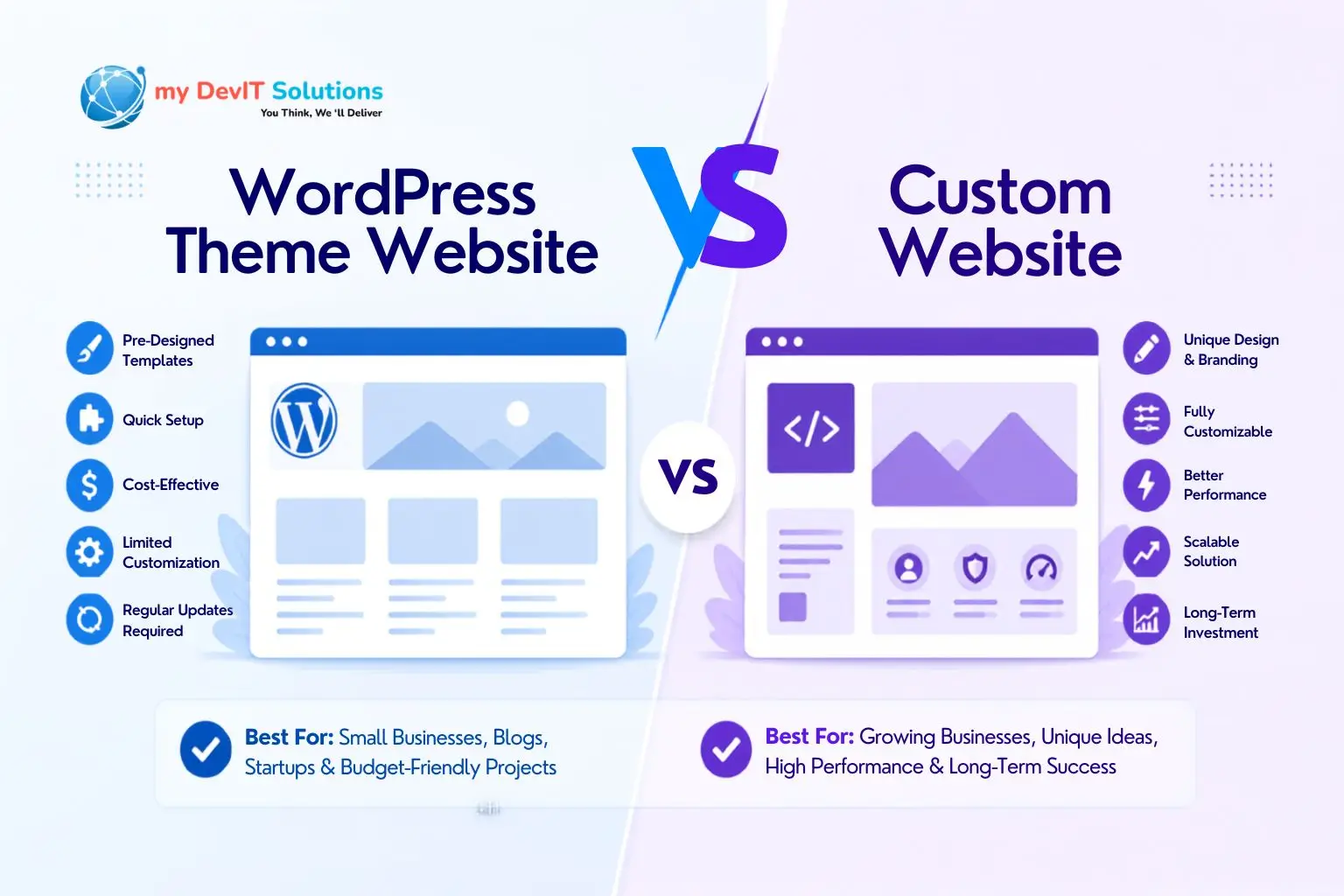
WordPress Theme Website vs Custom Website
Choosing between a WordPress Theme Website vs Custom Website is one of the biggest decisions you’ll make before your business goes online and it’s not a decision to make based on a friend’s opinion or a quick Google search. At my DevIT Solutions, we’ve built both types of websites for clients across industries, and we’ve seen firsthand what works, what fails, and what actually drives results in 2026. This guide goes deeper than most comparisons online: real 2026 data, real cost breakdowns, real SEO and Core Web Vitals numbers, so you can make a decision based on facts, not marketing fluff.
By the time you finish reading, you’ll know exactly which option fits your business whether you’re a solo entrepreneur, a growing brand, or an enterprise planning a long-term digital platform.
Why the WordPress Theme Website vs Custom Website Decision Matters in 2026
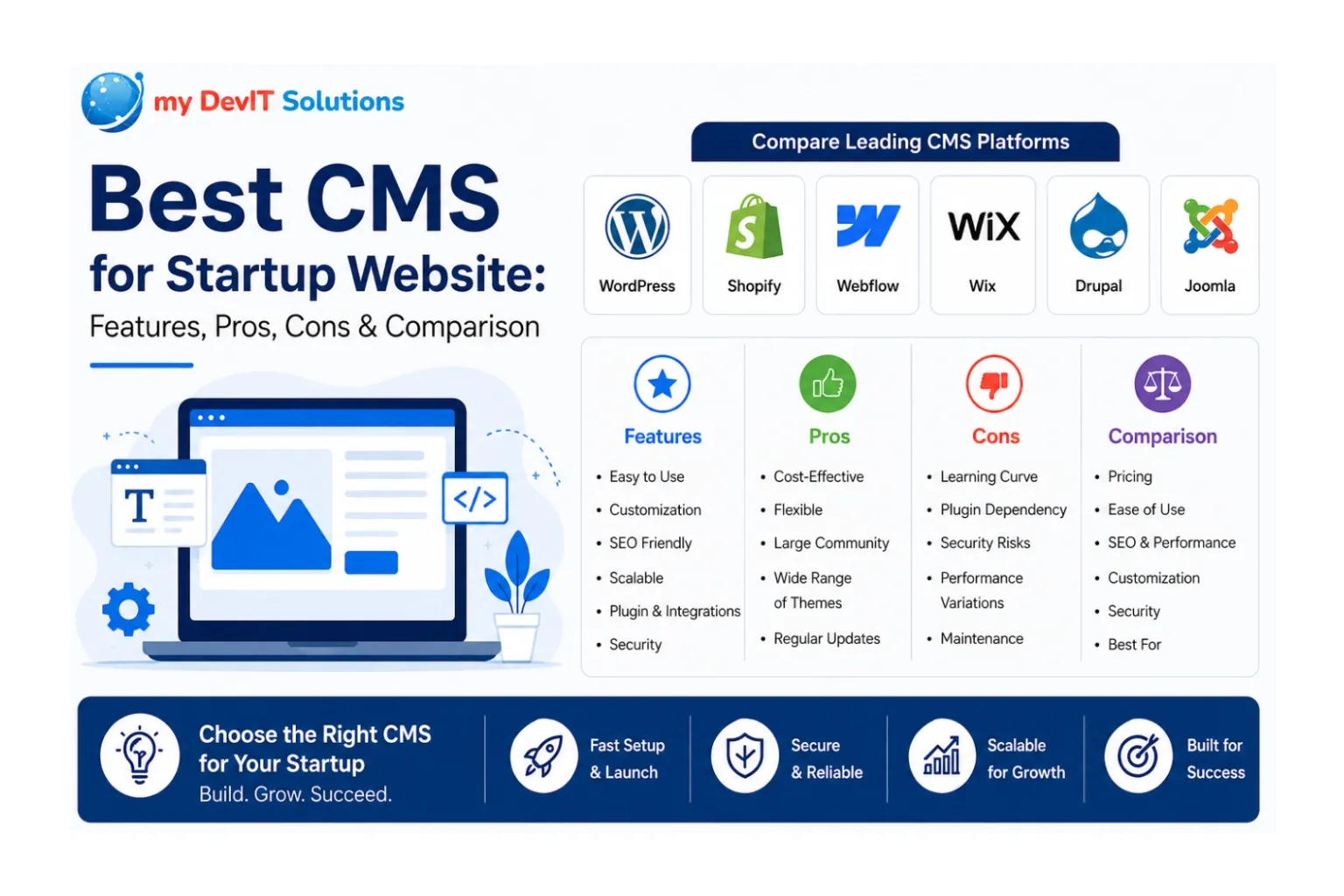
The web has changed dramatically. WordPress now powers roughly 43% of all websites globally and around 60% of the entire CMS market, making it the single most dominant platform on the internet. That scale brings real advantages: a massive plugin ecosystem, huge community support, and constant innovation, including WordPress’s new native AI infrastructure layer rolling out through WordPress 7.0 in 2026.
But scale also brings tradeoffs. Independent benchmarking shows the average WordPress page now loads in around 3.4 seconds, well above the 2.5-second threshold Google recommends for healthy Core Web Vitals, while modern custom-built frameworks like Next.js average closer to 0.8 seconds. This is the central tension in the custom website vs WordPress website debate today: WordPress gives you speed-to-launch and ease of use, while custom development gives you speed-to-load and long-term control.
What is a WordPress Theme Website?
A WordPress theme website is built using WordPress core software combined with a pre-designed theme either free (from the WordPress.org directory) or premium (from marketplaces like ThemeForest, or page builders like Elementor, Divi, and Astra). You install WordPress, activate a theme, customize it visually, add plugins for extra functionality, and your site can go live within days.
Key Characteristics of WordPress Theme Websites
- Built on pre-coded templates with a fixed underlying structure
- Functionality extended through plugins (forms, SEO, security, e-commerce)
- Fast to launch and inexpensive to start
- Requires ongoing core, theme, and plugin updates
- Backed by a massive global community and documentation library
What is a Custom Website?
A custom website is built from scratch by developers using languages and frameworks such as PHP, Laravel, React, or Next.js sometimes paired with a headless CMS. Nothing is templated. The database structure, the front-end interface, the user flow, and the backend logic are all engineered specifically around your business requirements.
Key Characteristics of Custom Websites
- Architecture built entirely around your business logic and user journey
- Zero dependency on third-party theme compatibility or marketplace plugins
- Higher upfront investment and longer development timeline
- Complete control over performance, security architecture, and scalability
- Requires an experienced development partner, such as my DevIT Solutions
WordPress Theme Website vs Custom Website: Quick Comparison Table
| Factor | WordPress Theme Website | Custom Website |
|---|---|---|
| Development Time | 1–3 weeks | 6–16 weeks |
| Initial Cost | Low ($300 – $3,000) | High ($5,000 – $50,000+) |
| Design Flexibility | Limited by theme structure | Unlimited |
| Average Load Time | ~3.4 seconds (industry average) | Often under 1.5 seconds |
| Scalability | Limited at high traffic | Built to scale |
| Maintenance | Frequent updates required | Lower long-term maintenance |
| Best For | Small businesses, blogs, startups | Enterprises, SaaS, high-traffic platforms |
Cost Comparison: Custom Built Website vs WordPress
Cost is the first thing most business owners look at, but the cheapest option upfront isn’t always the cheapest option over five years. A fair Custom Built Website vs WordPress comparison has to factor in plugin licensing, hosting upgrades, security patching, and the cost of a future redesign not just the initial invoice.
| Cost Component | WordPress Theme Website | Custom Website |
|---|---|---|
| Initial Build | $300 – $3,000 | $5,000 – $50,000+ |
| Premium Plugins (Annual) | $200 – $1,500/year | Usually built-in, no recurring fee |
| Theme License/Updates | $50 – $200/year | Not applicable |
| Hosting | $5 – $50/month (shared/managed) | $20 – $300/month (cloud/dedicated) |
| Redesign After 3–5 Years | Often requires a near-full rebuild | Easier to extend and upgrade modules |
| 5-Year Total Cost of Ownership | Moderate, but can rise sharply with plugin stacking | High upfront, more predictable afterward |
If you’re testing an idea, running a local business, or launching your first online presence, WordPress remains the financially smarter route. If you’re building a product designed to scale into tens of thousands of daily users, the custom route avoids the costly rebuild cycle WordPress sites often hit around year three to five.
Performance and Core Web Vitals in the WordPress Theme Website vs Custom Website Comparison
Google’s ranking systems continue to weight page experience signals heavily Largest Contentful Paint (LCP), Interaction to Next Paint (INP), and Cumulative Layout Shift (CLS) all factor into how your site is evaluated. This is where the custom website vs WordPress website comparison gets technical, and where the data is the most revealing.
Industry benchmarking in 2026 shows the average WordPress page loading in roughly 3.4 seconds, largely due to plugin stacking sliders, page builders, chat widgets, and pop-ups all add extra code the browser has to process. Custom-built sites, free of that overhead, average significantly faster load times because nothing unnecessary ships to the browser in the first place.
That doesn’t mean WordPress is doomed to be slow. A well-optimized WordPress theme site, using a lightweight theme, proper caching, image compression, and a CDN, can absolutely hit strong Core Web Vitals scores. The real difference is effort: a custom site is fast by design, while a WordPress site has to be made fast through active, ongoing optimization.
| Performance Metric | WordPress Theme Website | Custom Website |
|---|---|---|
| Average Load Time (Industry Data) | ~3.4 seconds | ~0.8 – 1.5 seconds |
| Code Bloat Risk | High (plugin-dependent) | Low (purpose-built) |
| Core Web Vitals Pass Rate | Moderate, needs active optimization | High, by design |
| CDN/Caching Setup | Plugin-based | Native/custom configuration |
| Mobile Responsiveness | Theme-dependent | Fully controlled |
SEO Considerations: WordPress Theme Website vs Custom Website Rankings
Neither WordPress nor custom code inherently ranks higher in Google. What actually drives rankings is technical SEO health: clean code, fast load times, mobile usability, structured data, and content quality regardless of the platform underneath. WordPress has a practical edge for non-technical teams because plugins like Yoast and RankMath simplify on-page SEO. Custom websites require SEO to be engineered directly into the architecture, which demands more upfront expertise but gives far more precision.
It’s also worth understanding how the search landscape itself is shifting. How SEO Is Affected By AI is now a real concern for every business owner, not a future hypothetical Google’s AI Overviews and generative search results are changing how content gets surfaced and summarized. Both WordPress and custom sites need clean schema markup, clear content hierarchies, and genuinely useful content to stay visible as AI-driven search continues to expand in 2026.
On-Page SEO Comparison
| SEO Factor | WordPress Theme Website | Custom Website |
|---|---|---|
| Schema Markup | Plugin-assisted | Manually coded, more precise |
| URL Structure Control | Good (via SEO plugins) | Full control |
| Site Speed Optimization | Requires plugins/tools | Built-in optimization |
| Content Management Ease | Very beginner-friendly | Requires CMS training or dev support |
| Crawlability | Generally good | Excellent, no plugin conflicts |
Security: A Factor Too Many Businesses Overlook
WordPress’s massive popularity is also its biggest security liability powering over 40% of the web makes it a constant target for automated attacks, brute-force login attempts, and exploits tied to outdated plugins. The vast majority of WordPress vulnerabilities don’t come from WordPress core itself, but from third-party plugins and themes that aren’t kept updated. Regular updates, reputable security plugins, and managed hosting significantly reduce this risk, but the responsibility ultimately sits with the site owner.
Custom websites aren’t automatically more secure by default security still depends entirely on how the development team writes and maintains the codebase. What custom sites do avoid is the unpredictable risk of dozens of third-party plugins built by unrelated developers, which keeps the attack surface smaller and easier for a dedicated team to monitor and patch.
Scalability: Building for Where You’re Headed, Not Just Where You Are
If you’re running a small business website, a blog, or a local service site, WordPress can comfortably support your traffic for years without issue. But if you’re building a SaaS platform, a marketplace, or any application involving complex user roles, real-time data, or heavy backend logic, a custom-built solution stops being optional and becomes a necessity. This is exactly the scenario where businesses turn to Trusted Web Application & Development Services in USA to design systems that scale horizontally instead of breaking under growth.
When Should You Choose a WordPress Theme Website?
- You need a website live quickly days, not months
- Your budget is limited, especially as a startup or small business
- You want to manage content yourself without hiring a developer
- Your site’s core purpose is informational, a blog, or a small online store
- You don’t need highly custom functionality or third-party integrations
When Should You Choose a Custom Website?
- You’re building a SaaS product, marketplace, or full-scale web application
- You need complete control over performance, design, and architecture
- You’re expecting rapid growth or high, fluctuating traffic volumes
- You require integrations with internal tools, APIs, or proprietary systems
- Long-term scalability matters more to you than short-term savings
For businesses unsure which direction actually fits their goals, working with a team that delivers Website Design & Development Business Intelligence can help map the right technology decision against real usage data, instead of guesswork.
Maintenance and Long-Term Ownership
WordPress theme websites need consistent maintenance: core updates, plugin updates, theme compatibility checks, and regular backups. Skipping any of these consistently is how sites end up hacked or broken by a conflicting update. Custom websites, once properly built, typically need less frequent intervention but when changes are needed, they require a developer rather than a one-click plugin update.
| Maintenance Factor | WordPress Theme Website | Custom Website |
|---|---|---|
| Update Frequency | Frequent (weekly/monthly) | Infrequent, as-needed |
| Who Can Maintain It | Site owner or freelancer | Requires a skilled developer |
| Risk of Plugin Conflicts | Moderate to high | None |
| Backup Requirements | Critical, regular backups needed | Built into the deployment pipeline |
WordPress in 2026: What’s Actually Changing
It’s worth noting that WordPress isn’t standing still. WordPress 7.0 is introducing native AI infrastructure directly into core, along with real-time collaborative editing and a redesigned admin interface a clear sign the platform is adapting to the AI-driven web rather than ignoring it. This matters for the WordPress Theme Website vs Custom Website decision because it narrows one historical gap: WordPress is becoming more capable of supporting modern, AI-assisted workflows without needing a fully custom build just to access that functionality. Still, for performance-critical or highly specialized applications, custom development retains a clear structural advantage.
Real-World Recommendation from my DevIT Solutions
After years of building both WordPress and custom solutions across different industries, our position at my DevIT Solutions is straightforward: there’s no universal “better” choice only the option that’s better for your specific business stage and goals. A local bakery, a consulting firm, or a personal brand rarely needs a fully custom-coded platform; a clean, well-optimized WordPress site will serve them effectively for years. But a fintech startup, a logistics platform, or any business with complex internal workflows will outgrow WordPress quickly and gain far more value from a custom build engineered around their exact processes.
If you’re still weighing your options, partnering with a team offering Best Website Design Development and SEO Services in USA ensures your decision is backed by technical evaluation and real performance data, not just whichever trend is loudest this year.
Conclusion
The WordPress Theme Website vs Custom Website decision ultimately comes down to three things: your budget, your timeline, and where you expect your business to be in three to five years. WordPress remains an excellent, cost-effective choice for small businesses, bloggers, and startups that need to launch fast and manage content independently. Custom websites, while requiring a larger upfront investment, deliver unmatched flexibility, performance, and scalability for businesses with complex needs or serious growth ambitions.
Whichever direction you choose, what matters most is partnering with a team that understands both technologies well enough to guide you honestly not push you toward whatever’s easier to sell. That’s the approach we follow at my DevIT Solutions, and it’s why businesses trust us with both their WordPress and custom development projects.
FAQs
Yes, custom website development almost always costs significantly more upfront than a WordPress theme-based site.
Yes, with proper optimization, a WordPress site can achieve the same SEO performance as a custom-built website.
A WordPress site can launch in 1–3 weeks, while a custom website typically takes 6–16 weeks depending on complexity.
Yes, WordPress is secure when kept updated and managed with trusted plugins and proper security practices.
Most startups should start with WordPress for lower cost and faster launch, then transition to custom later if needed.
Yes, many businesses start on WordPress and migrate to a custom-built platform as their needs grow.
Yes, WordPress with WooCommerce comfortably supports most small-to-mid-sized e-commerce businesses.
Custom websites generally offer stronger long-term scalability for high-traffic or technically complex applications.