

If you have watched your rankings swing after a core update, you already know why EEAT in SEO has become the most talked-about topic in search marketing. At my DevIT Solutions, we work with businesses every day who want to understand why some pages rank consistently while others disappear overnight. The short answer is trust. Google no longer rewards keyword-stuffed pages or thin content it rewards websites that prove real experience, expertise, authority, and trustworthiness. This guide breaks down exactly what EEAT in SEO means in 2026, why the recent EEAT Google update changed the game, and how you can apply it to your own website starting today.
What Is E-E-A-T in SEO?
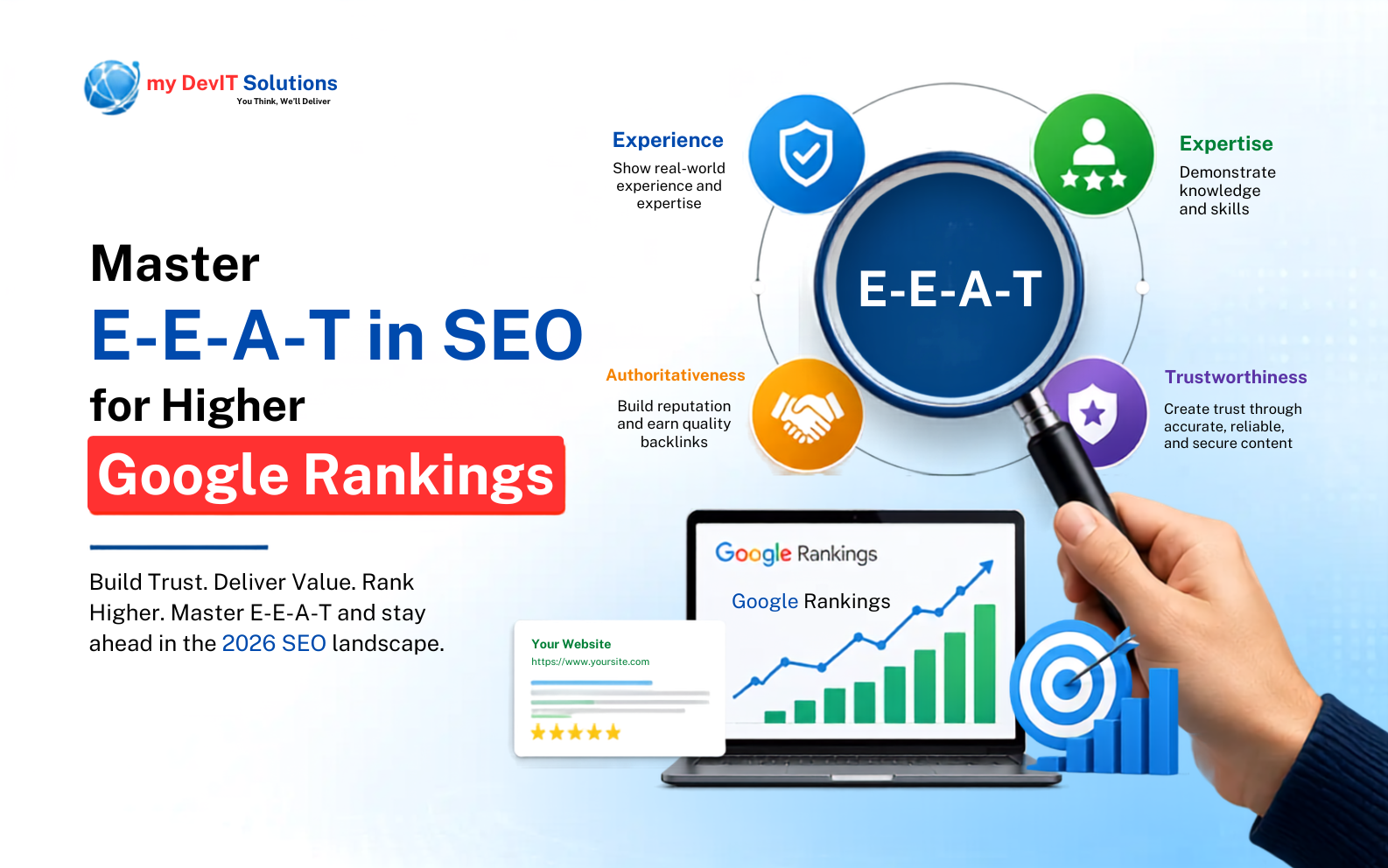
E-E-A-T stands for Experience, Expertise, Authoritativeness, and Trustworthiness. It originates from Google’s Search Quality Rater Guidelines, the handbook human reviewers use to evaluate whether search results are genuinely helpful. While E-E-A-T is not a direct ranking factor you can “install” on a page, it reflects the signals Google’s algorithms are trained to detect things like author credibility, factual accuracy, original insight, and reputation across the web.
Understanding EEAT in SEO means understanding that Google is asking one core question about every page it indexes: can this content be trusted to help a real person? Pages that answer “yes” convincingly tend to outperform pages that merely look comprehensive on the surface.
The Four Pillars Explained
| Pillar | What It Means | Example Signal |
|---|---|---|
| Experience | First-hand, lived involvement with the topic | Original photos, personal testing notes, real outcomes |
| Expertise | Depth of knowledge or formal qualification | Author bios, credentials, consistent topic coverage |
| Authoritativeness | External recognition as a go-to source | Backlinks, citations, industry mentions |
| Trustworthiness | Accuracy, transparency, and safety of the content | Fact-checked claims, clear ownership, secure site |
Why EEAT in SEO Matters More Than Ever
Search has changed dramatically. AI Overviews now appear in the majority of search results, and generative tools can produce content at a scale no human writer ever could. This flood of synthetic content is exactly why Google leans harder on EEAT in SEO it is one of the few reliable ways to separate genuinely useful pages from mass-produced filler. Businesses exploring How SEO Is Affected By AI are finding that the same experience-driven signals that satisfy Google’s Quality Raters also make content more likely to be cited inside AI-generated answers.
Trustworthiness sits at the center of the framework. Without it, experience, expertise, and authority carry very little weight, because a reader (or an algorithm) has no reason to believe any of the other signals are genuine. That is why even a technically well-optimized page can underperform if it lacks transparency, accurate sourcing, or a verifiable author.
The Latest EEAT Google Update: What Changed in 2026
The most significant shift arrived with Google’s March 2026 core update, which noticeably amplified the “Experience” pillar beyond every prior signal. Content built on genuine first-hand outcomes, original data, and verifiable author credentials began outranking comprehensive but impersonal information pages almost overnight. Sites that had built authority purely through topical coverage and backlinks without any experiential depth saw real declines.
| Update | Approx. Date | Core Focus |
|---|---|---|
| Helpful Content System | 2022–2023 | Rewarding people-first content over search-engine-first content |
| December 2025 Core Update | Dec 2025 | Broad content quality and site value reassessment |
| February 2026 Core Update | Feb 2026 | Penalizing clickbait and sensational titles |
| March 2026 Core Update | Mar 2026 | Major boost to Experience signals within EEAT in SEO |
| April 2026 Core Update | Apr 2026 | Reinforced author identity as a ranking factor |
This EEAT Google update did not penalize AI-assisted writing outright. What it penalized was content lacking evidence of real human involvement. Pages assisted by AI but substantially edited, fact-checked, and attributed to a named expert continued to perform well, while anonymous, generic, or unedited AI output lost visibility. Health, finance, legal, and home-service niches the classic YMYL (“Your Money or Your Life”) categories experienced the sharpest volatility, since Google’s Quality Raters apply the strictest EEAT in SEO scrutiny wherever a wrong answer could cause real harm.
Building Real Experience Signals
Experience is now the single biggest differentiator in EEAT in SEO. To demonstrate it convincingly:
- Include original photos, screenshots, or videos from actual use of a product or process, not stock imagery.
- Write from a documented, first-person point of view when reviewing tools, services, or experiences.
- Share specific outcomes numbers, timelines, and results rather than generic summaries.
- Disclose clearly when the author has personally used, visited, or lived through the subject matter.
Agencies offering Trusted Web Application & Development Services in USA often build client case studies around exactly this principle, showing real project timelines and measurable results instead of vague promises.
Demonstrating Expertise on Your Website
Expertise is shown through consistent, accurate, and well-sourced content, not just credentials listed on an “About” page. Google’s raters look for command of a subject that holds up under scrutiny content that anticipates follow-up questions and explains concepts precisely.
Practical ways to strengthen expertise include publishing detailed author bios with real qualifications, maintaining a consistent publishing history around one subject area rather than jumping between unrelated topics, and citing primary sources, studies, or official documentation wherever a claim is made. A site that focuses narrowly on one niche and covers it in real depth tends to build expertise signals faster than one that publishes shallow content across many unrelated categories.
Earning Authoritativeness the Right Way
Authoritativeness cannot be claimed it has to be earned externally. Google measures it through recognition that exists outside your own website: backlinks from reputable, relevant sources, mentions on respected industry publications, and citations that treat your brand as a credible reference point.
Digital PR and editorial placements now carry significant weight here, often more than traditional directory-style link building. A company offering Premium Professional SEO Services in Germany, for example, builds authority not just through backlinks but through genuine coverage in industry press and partnerships with recognized voices in its field.
Strengthening Trustworthiness
Trustworthiness ties every other pillar together, and it is the easiest to damage and the hardest to rebuild. Google evaluates it by looking at accuracy, transparency, and the overall experience a visitor has on your site.
| EEAT Pillar | Quick Win | Long-Term Action |
|---|---|---|
| Experience | Add real photos or a first-person note | Build a library of case studies and documented outcomes |
| Expertise | Add author name and short bio | Publish consistently in one topic cluster with citations |
| Authoritativeness | List existing partnerships or press mentions | Earn backlinks and coverage from industry-relevant sites |
| Trustworthiness | Add HTTPS, contact info, and clear ownership | Fact-check regularly and correct errors transparently |
Simple, often-overlooked steps make a real difference: securing the site with HTTPS, publishing clear privacy and contact information, displaying genuine customer reviews, and updating outdated content instead of leaving it stale. Outdated information is one of the fastest ways to lose reader and algorithm trust alike, which is why refreshing older articles should be a routine part of any EEAT in SEO strategy.
YMYL Content and Why It Demands Extra Care
Your Money or Your Life (YMYL) topics health, finance, legal advice, and safety are held to the highest EEAT standard because inaccurate advice in these areas can cause genuine harm. If your business operates in one of these spaces, every claim should be verifiable, every author should be identifiable, and every page should be reviewed for accuracy on a regular schedule. Even outside strict YMYL categories, applying the same discipline builds a stronger overall trust profile across your entire domain.
Common EEAT Mistakes and How to Fix Them
Many businesses assume EEAT in SEO is something they can simply “add” to a page with a sentence or two. Google has been direct about this: you cannot bolt on experience or expertise after the fact it has to be genuinely demonstrated throughout the content and the site itself.
| Common Mistake | Why It Hurts Rankings | Better Approach |
|---|---|---|
| Anonymous or generic author bylines | Reduces attribution and verifiable credibility | Use named authors with real, checkable credentials |
| Publishing unedited AI content at scale | Signals lack of human oversight | Have subject-matter experts edit and fact-check AI drafts |
| No original data, images, or examples | Reads as generic and impersonal | Add first-hand outcomes, screenshots, or case data |
| Ignoring outdated pages | Signals stale, unreliable information | Schedule regular content audits and updates |
Businesses that invest in a full-service approach covering technical health, content quality, and design tend to recover fastest after an EEAT Google update. That is exactly the gap a firm offering Best Website Design Development and SEO Services in USA is built to close, aligning site structure and content strategy under one coherent EEAT-focused plan.
How my DevIT Solutions Helps You Master EEAT in SEO
At my DevIT Solutions, our team combines technical SEO, content strategy, and web development to help brands build every pillar of EEAT in SEO from the ground up. We audit existing content for experience gaps, structure author authority correctly, strengthen backlink profiles through relevant digital PR, and make sure your site’s technical foundation supports the trust signals Google is actively rewarding. For growing companies, we also provide Best IT Consulting Services for Startups USA, helping newer brands build credible digital foundations instead of chasing shortcuts that get penalized in the next core update.
EEAT in SEO is not a one-time checklist it is an ongoing commitment. The businesses that treat it as ongoing infrastructure, rather than a quick fix, are the ones that keep climbing through every EEAT Google update rather than getting knocked back down.
Conclusion
Mastering EEAT in SEO in 2026 means accepting that Google’s algorithms are built to reward authenticity over volume. Experience now carries more weight than ever, expertise must be demonstrated consistently, authority must be earned externally, and trust must be protected at every level of your site. The most recent EEAT Google update made this clearer than any previous change: comprehensive content without real human involvement is no longer enough. By building genuine author credibility, publishing original insights, earning relevant backlinks, and keeping your content accurate and current, you give your website the strongest possible foundation for sustainable rankings not just for today’s algorithm, but for whatever comes next.
FAQs
EEAT stands for Experience, Expertise, Authoritativeness, and Trustworthiness, the framework Google’s Quality Raters use to judge content quality.
No, EEAT itself is not a single ranking factor, but it reflects underlying signals that Google’s algorithms use to evaluate page and site quality.
The March 2026 core update significantly increased the weight given to first-hand Experience signals over generic, impersonal content.
Yes, as long as it is substantially edited, fact-checked, and attributed to a verifiable human expert rather than published unedited at scale.
Because without trust, the other pillars of experience, expertise, and authority carry little value to readers or to Google’s algorithms.
You should review and refresh key pages regularly, since outdated information is one of the fastest ways to lose trust signals.
Yes, the same experience-driven, well-sourced content that satisfies Google’s Quality Raters is also more likely to be cited in AI-generated answers.