

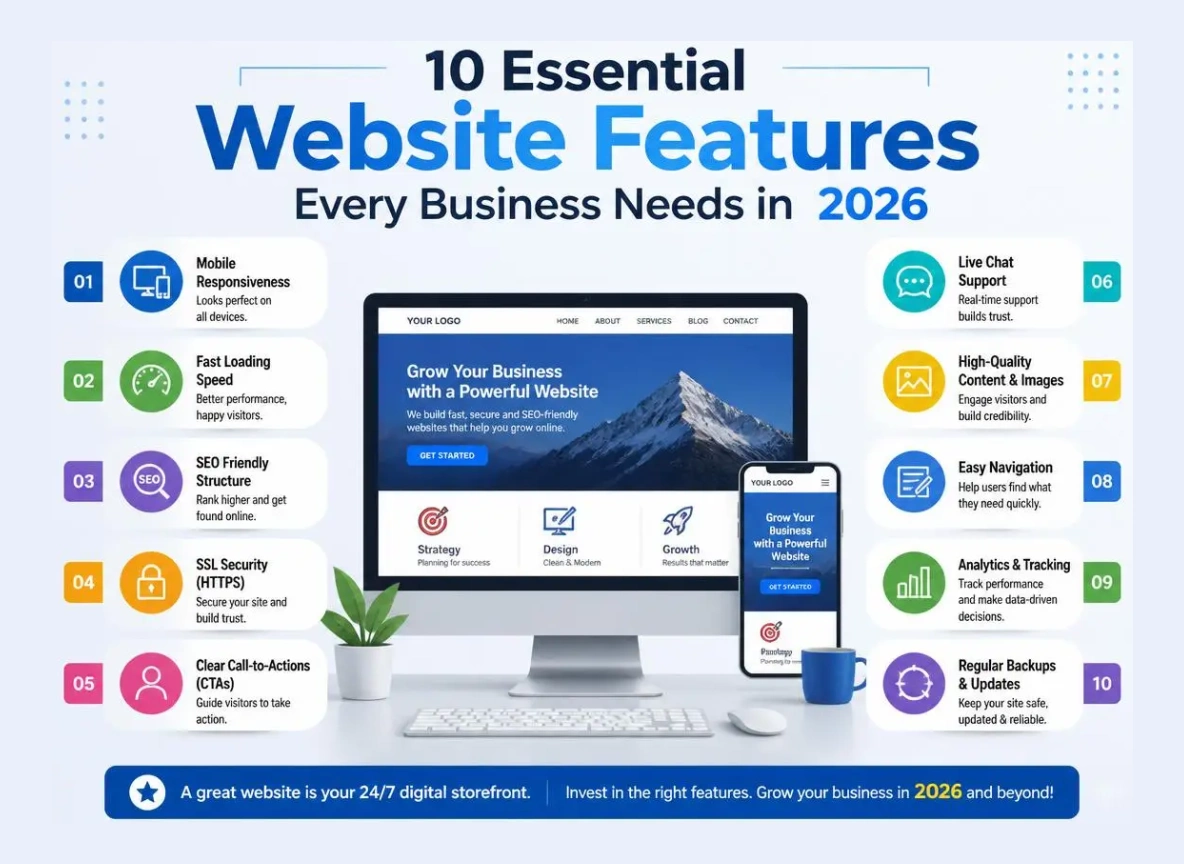
A website is no longer a digital brochure it is the single most important salesperson your business owns, working 24/7 without a day off. At my DevIT Solutions, we have audited hundreds of business websites over the last year, and one truth keeps repeating itself: companies that update their Website Features Every Business Needs consistently outrank, outconvert, and outlast companies that treat their site as a “set it and forget it” project. In 2026, search engines, AI assistants, and users all judge websites by the same standards speed, trust, clarity, and usefulness. This guide breaks down the ten features that matter most this year, backed by current industry data, and shows you exactly why each one deserves a place on your roadmap.
Why Website Features Every Business Needs Are Changing in 2026
The web has quietly gone through three shifts at once: AI-powered search, mobile-only browsing habits, and stricter accessibility law. User behavior is shifting from traditional search engines to AI-powered conversational agents, and these large language models parse raw semantic code rather than visual design. That means a website built only to “look nice” is already behind. At the same time, nearly 61% of brands say AI-powered search is already reshaping how customers discover them online, and 2026 is redefining web design around making the web faster, smarter, more inclusive, and more human. Below is a quick snapshot of the ten features every modern business site should have, followed by a detailed breakdown of each.
Quick Overview of Website Features Every Business Needs in 2026
| Feature | Primary Benefit | Business Impact |
| Mobile-First & Thumb-Friendly Design | Better usability on phones | Higher engagement, lower bounce rate |
| Core Web Vitals & Site Speed | Faster load times | Higher rankings, more leads |
| AI-Powered Personalization | Tailored user journeys | Higher conversion rates |
| Robust Security (SSL, WAF, 2FA) | Data protection | Customer trust, legal compliance |
| SEO, AEO & GEO Optimization | Visibility in AI search | More qualified organic traffic |
| Accessibility (WCAG Compliance) | Inclusive experience | Wider audience, legal protection |
| Conversion-Focused CTAs | Clear next steps | More inquiries and sales |
| Scalable CMS | Easy content updates | Lower long-term maintenance cost |
| Business Tool Integrations | Automated workflows | Time and cost savings |
| Sustainable & Ethical Design | Lightweight, privacy-first code | Better performance and reputation |
1. Mobile-First & Thumb-Friendly Navigation
Mobile browsing has moved past “responsive” into something more specific: thumb-friendly. In 2026, web design trends continue to focus on creating websites that are thumb-friendly, placing navigation, menus, and even contact buttons in the space a thumb can naturally reach. If your menu forces users to stretch across the screen, you are quietly losing visitors before they even see your offer. This is one of the most overlooked Website Features Every Business Needs, yet it is one of the cheapest to fix.
For companies without an in-house team, working with a Trusted Web Application & Development Services in USA provider ensures your navigation is rebuilt around real thumb-reach zones rather than desktop habits copied onto a smaller screen.
2. Core Web Vitals and Real Site Speed
Speed is no longer a “nice to have” metric buried in a developer report it is a ranking factor and a trust signal. Fast-loading, responsive sites rank higher, retain more users, and convert better, and designers who master performance strengthen business outcomes as a competitive edge. Heavy, unoptimized images and bloated plugins are still the number-one reason business websites fail speed tests in 2026.
Core Web Vitals Benchmarks for 2026
| Metric | What It Measures | 2026 Target |
|---|---|---|
| LCP (Largest Contentful Paint) | Loading speed of main content | Under 2.5 seconds |
| INP (Interaction to Next Paint) | Responsiveness to clicks/taps | Under 200 milliseconds |
| CLS (Cumulative Layout Shift) | Visual stability while loading | Under 0.1 |
| TTFB (Time to First Byte) | Server response speed | Under 800 milliseconds |
Businesses serious about ranking should treat these benchmarks as non-negotiable, not aspirational.
3. AI-Powered Personalization and Smart Chatbots
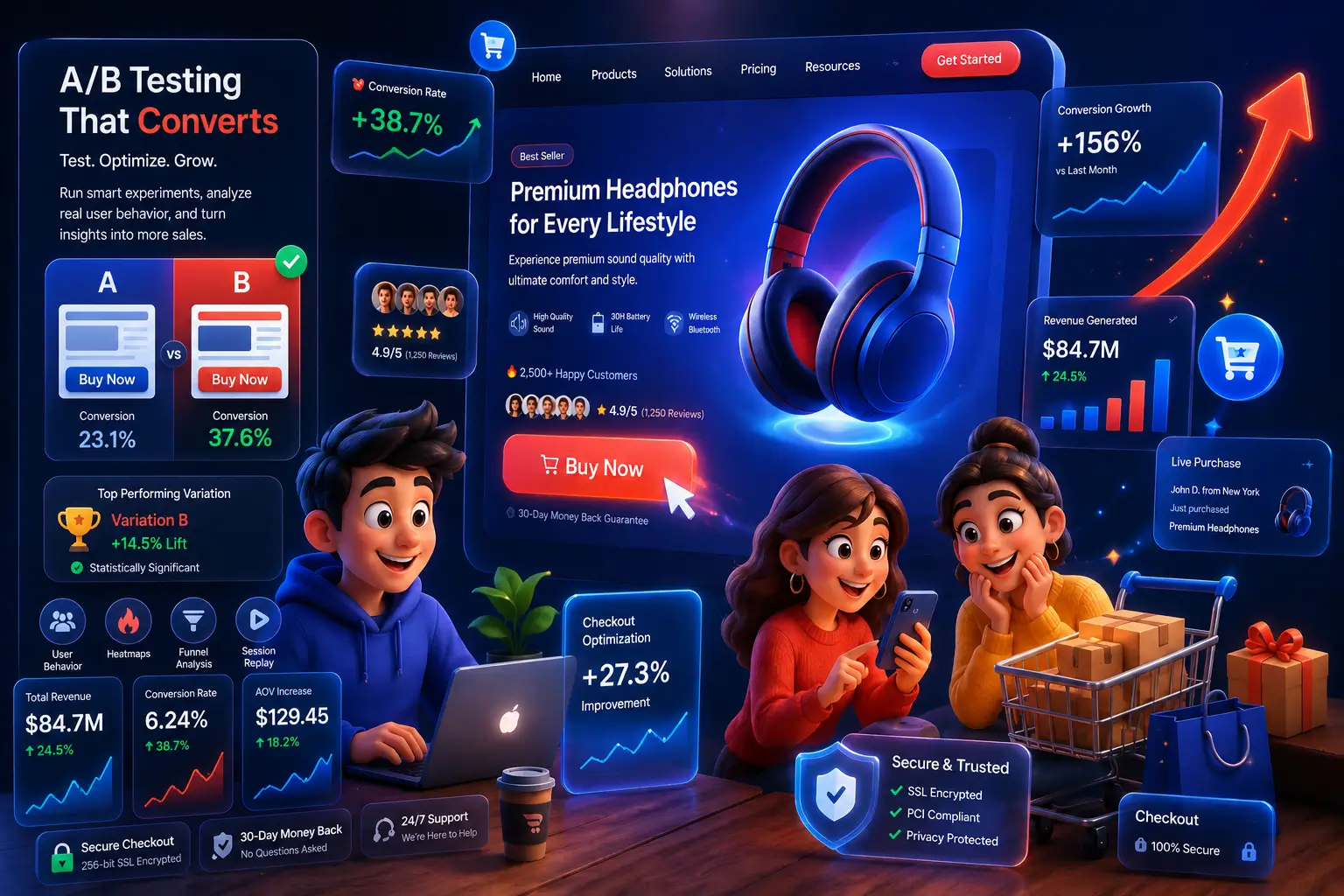
Static websites that show the exact same homepage to every visitor are quickly becoming outdated. AI now allows a site to adjust based on browsing behavior, location, or return-visit history. One documented case showed a store gaining a notable jump in conversions simply by letting an algorithm reposition its main call-to-action button based on where users naturally looked. Chat-based assistants also reduce response time for common questions, freeing up your team for higher-value conversations.
Understanding How SEO Is Affected By AI is essential here, since AI-driven personalization and AI-driven search discovery are now deeply connected a site that adapts intelligently to users often earns better engagement signals that search engines reward.
4. Robust Security Features
Security is one of the Website Features Every Business Needs that customers rarely mention until it’s missing. SSL certificates, web application firewalls (WAFs), regular malware scanning, and two-factor authentication for admin logins are now baseline expectations, not premium add-ons. A single breach can undo years of brand trust in a single news cycle. Certain aspects of web design will always remain crucial, such as user-friendly navigation, data security, and swift loading times, and this remains just as true heading into 2026 as it was five years ago.
5. SEO, AEO, and GEO Optimization
Traditional SEO now shares the stage with Answer Engine Optimization (AEO) and Generative Engine Optimization (GEO). Today’s search engines use AI to understand content, making structured data even more important, and many leading development practices now emphasize AEO and GEO. Clean heading structures, schema markup, and clear semantic HTML help both traditional crawlers and AI models correctly interpret and cite your business.
Traditional SEO vs. AEO/GEO Focus in 2026
| Aspect | Traditional SEO | AEO/GEO (AI Search) |
|---|---|---|
| Primary Goal | Rank on search results page | Get cited inside AI-generated answers |
| Content Style | Keyword-optimized long-form | Direct, structured, question-answer format |
| Technical Need | Meta tags, backlinks | Schema markup, semantic HTML, clean code |
| Success Metric | Organic clicks | Brand mentions & citations in AI responses |
If your current provider hasn’t updated their approach for AI search, it may be time to consult a team offering Premium Professional SEO Services in USA or a similarly specialized agency that tracks both classic rankings and AI citation visibility.
6. Accessibility and WCAG Compliance
Accessibility has moved from a “nice extra” to a legal and reputational requirement. As laws like the European Accessibility Act take effect, accessibility is now both a legal requirement and a creative advantage, with WCAG compliance shaping global standards. Features like proper color contrast, ARIA labels, keyboard navigation, and alt text aren’t just for users with disabilities they improve usability for everyone and reduce legal exposure for the business.
7. Clear, Conversion-Focused Calls-to-Action
A beautiful website that doesn’t guide visitors toward a next step is simply an expensive piece of art. Every page should have one obvious, low-friction action “Book a Call,” “Get a Free Quote,” “Start Free Trial.” Clarity beats cleverness: for both B2B and B2C brands, design plays a critical role in guiding users from discovery to conversion, and clarity beats cleverness every time. This is where many otherwise well-designed sites quietly lose revenue.
8. A Scalable Content Management System
A modern CMS helps your business grow instead of holding it back. Your marketing team can publish blogs, update pricing, and launch landing pages without waiting weeks for a developer. A modular, block-based architecture gives you complete flexibility by letting you rearrange, update, and A/B test individual sections without affecting the rest of the page.
Must-Have vs. Nice-to-Have Website Features
| Category | Must-Have in 2026 | Nice-to-Have (Optional) |
|---|---|---|
| Performance | Fast load speed, Core Web Vitals | 3D animations |
| Design | Mobile-first, accessible layout | Dark-mode toggle |
| Trust | SSL, security scanning, privacy policy | Live visitor counters |
| Discovery | SEO + AEO/GEO structured data | Voice search widgets |
| Engagement | Chatbot, clear CTAs | Gamified elements |
Businesses evaluating a rebuild often benefit from partnering with the Best Website Design Development and SEO Services in USA to make sure both the design layer and the technical SEO layer are handled by one accountable team instead of two disconnected vendors.
9. Integration With Business Tools
Your website shouldn’t operate in isolation. CRM integration, payment gateways, appointment scheduling, email marketing sync, and analytics dashboards all turn your site into an operational hub rather than a static page. Websites are evolving from digital storefronts into the command centers of modern businesses, and in 2026 a site is no longer an isolated asset. This is precisely why so many companies now look for a full Web Design & Development Company in USA rather than juggling separate freelancers for each integration.
10. Sustainable, Privacy-First, and Ethical Design
The final piece is often the most overlooked: how responsibly your website is built. Ethical web design goes hand in hand with sustainability, emphasizing ethical UX, privacy-first design, data minimization, and transparency, and brands that fail to respond risk losing trust. Lightweight code, compressed next-gen image formats, and minimal third-party trackers all contribute to both a faster site and a more trustworthy brand image.
Startups in particular benefit from getting this right early, which is why many turn to the Best IT Consulting Services for Startups USA before their first line of code is written building sustainable, scalable foundations from day one is far cheaper than retrofitting them later.
How my DevIT Solutions Helps Businesses Build Future-Ready Websites
At My DevIT Solutions, we design more than websites—we build powerful business assets. Our team integrates performance engineering, AI-ready structured data, accessibility compliance, and conversion-focused design into every project. Whether you’re launching your first startup website or upgrading an enterprise platform, we plan, test, and optimize every essential website feature before launch instead of treating it as an afterthought.
Conclusion
In 2026, users judge websites within milliseconds, search engines analyze them alongside human visitors, and customers expect flawless performance on every mobile device. The businesses that win aren’t necessarily the ones with the biggest budgets they’re the ones that treat their website as a living, evolving system built around real user behavior and real search engine mechanics. By prioritizing speed, security, accessibility, AI-readiness, and conversion-focused design, you position your business to capture attention in both traditional search results and the new generation of AI-powered answers. Start with the features that affect trust and speed first, then layer in personalization and automation as your traffic grows.
FAQs
A: Mobile-first design, fast Core Web Vitals scores, strong security, AI-ready SEO, accessibility, and clear conversion-focused CTAs are the most important features this year.
A: Yes, Core Web Vitals like LCP, INP, and CLS directly influence both user experience and search engine rankings.
A: AI-powered search engines now read structured, semantic code to generate answers, so websites need clean HTML and schema markup to be cited correctly.
A: A custom-built website performs better long-term for speed, SEO, and branding, while templates work only as a short-term, low-budget starting point.
A: A full features audit is recommended at least once a year, with performance and security checks done monthly.