

If you’ve been working in Search Engine Optimization (SEO) for any length of time, you’ve probably heard the phrase “topical authority” thrown around like a buzzword. But what is topical authority in practice and why is it the single most powerful lever you can pull to rank faster in 2026? This guide breaks it all down with clarity, strategy, and actionable steps you can begin implementing today.
Google’s algorithms from Panda and Hummingbird to BERT, MUM, and the Helpful Content System have been progressively moving away from keyword-stuffing and toward genuine subject-matter depth. In this landscape, topical authority SEO isn’t optional; it’s the foundation of any sustainable organic strategy.
Key Insight:- Topical authority is Google’s way of measuring whether your website is a comprehensive, trustworthy resource on a subject not just a page that mentioned the right keyword.
What Is Topical Authority? A Clear Definition
Topical authority refers to the level of expertise, depth, and comprehensiveness a website demonstrates on a specific subject area. When Google recognizes your site as an authoritative source on a topic, it rewards you with higher rankings even for pages you haven’t aggressively optimized for keywords.
Think of it this way: if you have 50 deeply researched, interlinked articles about home solar energy covering installation, costs, panel types, inverters, battery storage, government subsidies, maintenance, and more Google begins to see your site the way a librarian sees an encyclopedia: as the go-to resource for that subject. That’s topical authority SEO at work.
It differs from domain authority (a metric measuring overall link popularity) in that topical authority is specifically about subject coverage. You don’t need to be a giant website to have high topical authority you need to be the most thorough, accurate, and well-structured source on your chosen niche.
Topical Authority vs. Domain Authority vs. Page Authority
| Metric | What It Measures | Influenced By | Relevance in 2026 |
|---|---|---|---|
| Topical Authority | Depth & breadth of subject coverage | Content clusters, internal links, semantic relevance | ⭐⭐⭐⭐⭐ Critical |
| Domain Authority (DA) | Overall site link popularity (Moz metric) | Backlinks, referring domains | ⭐⭐⭐ Moderate |
| Page Authority (PA) | Individual page link strength | Inbound links to that specific page | ⭐⭐⭐ Moderate |
| E-E-A-T Signals | Experience, Expertise, Authoritativeness, Trust | Author bios, citations, reviews, transparency | ⭐⭐⭐⭐⭐ Critical |
Why Topical Authority Matters More Than Ever in 2026
Google’s 2023 Helpful Content System update, its 2024 Core Updates, and its integration of AI-powered search features (AI Overviews) have all dramatically raised the bar for what constitutes “useful” content. Thin content, keyword-stuffed pages, and siloed single articles no longer compete they get suppressed.
According to multiple SEO studies, websites with strong topical authority in their niche consistently rank for 3–5x more keywords than comparable sites without it even when the latter have more backlinks. This is because Google’s NLP systems (BERT and MUM) can now understand semantic relationships between concepts, not just keyword frequency.
For businesses operating in competitive industries and especially for teams working with agencies like my DevIT Solutions building topical authority in SEO is the highest-ROI investment in organic growth available today. It compounds over time: each new article you publish reinforces the authority of the ones already live.
Google Algorithm Updates & Their Impact on Topical Authority
| Update | Year | Key Change | Topical Authority Impact |
|---|---|---|---|
| Hummingbird | 2013 | Conversational search & semantic understanding | First major push toward topic-based relevance |
| BERT | 2019 | NLP understanding of context and intent | Rewarded in-depth, naturally written content |
| MUM | 2021 | Multimodal, multilingual topic understanding | Boosted comprehensive topic clusters |
| Helpful Content System | 2022–2024 | Sitewide signal penalizing unhelpful content | Thin content drags down entire domain authority |
| Core Update (March 2024) | 2024 | Targeted low-quality, AI-spun, unoriginal content | Deep expertise and E-E-A-T became mandatory |
How to Build Topical Authority in SEO: A Step-by-Step Framework
Building topical authority in SEO is a structured, strategic process not a one-time content sprint. Here is the proven framework used by top-ranking sites and recommended by experts in the field of Digital Marketing:
- Choose Your Core Topic (Niche Selection):- Identify the broadest topic your site will own e.g., “personal finance,” “cloud security,” or “plant-based nutrition.” This becomes your topical universe. Be specific enough to compete but broad enough to generate 50–100+ subtopics.
- Build a Topic Cluster Map:- Create a pillar page for your core topic and map out all related subtopics, questions, and entities. Use tools like Ahrefs, Semrush, or Koala to surface semantic gaps. Every subtopic becomes a cluster article linked back to the pillar.
- Cover Every Search Intent Within Your Niche:- For each subtopic, address all four intent types: informational (“what is X”), navigational (“best X tool”), commercial (“X vs Y”), and transactional (“buy X”). Gaps in intent coverage = gaps in authority.
- Create Depth-First, Not Volume-First Content:- Google rewards thoroughness. Each article should answer the main question completely, address related questions, include data, examples, visuals, and real-world application. A single 2,500-word expert article beats five 500-word shallow pieces.
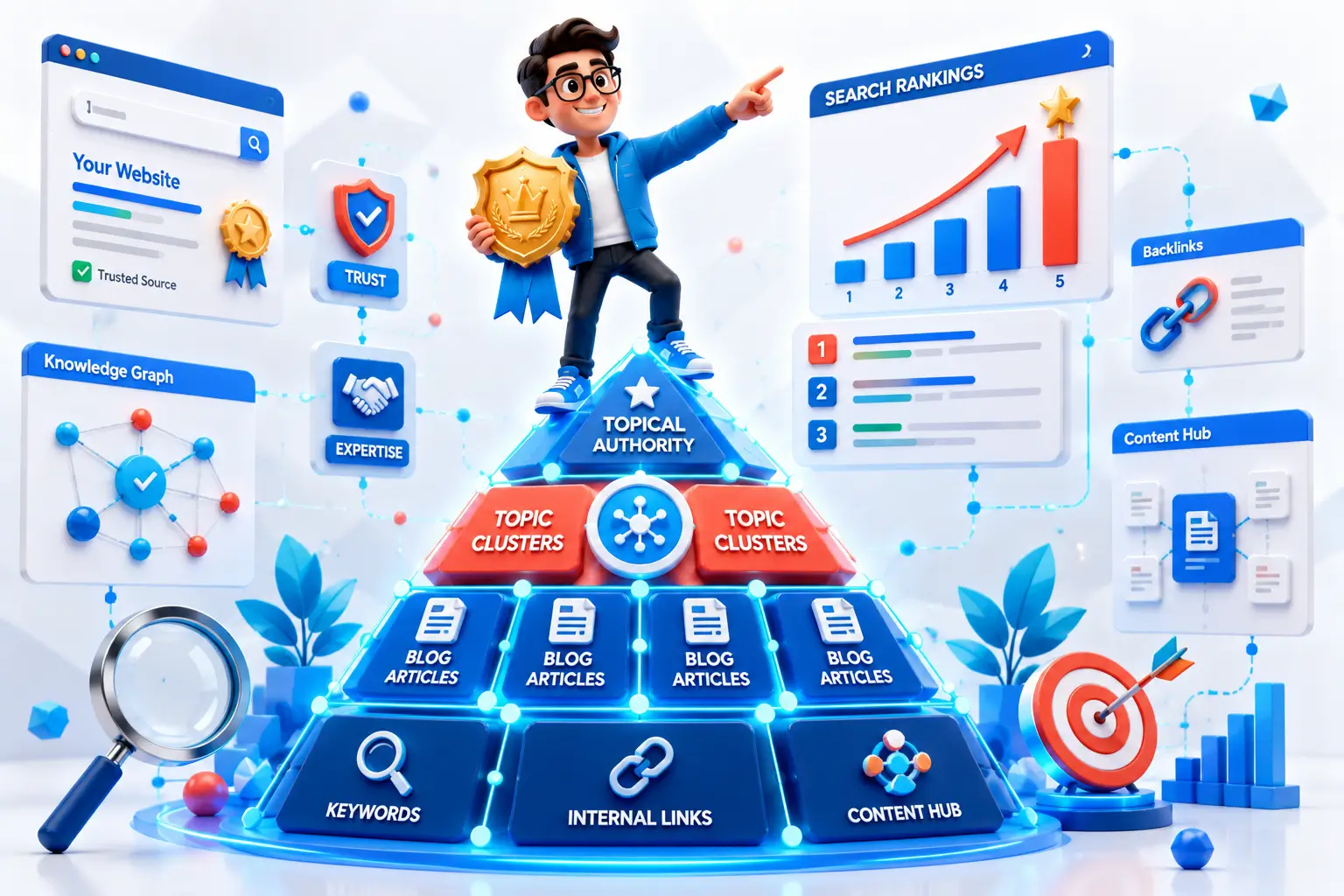
- Build Strategic Internal Links:- Connect all cluster articles to the pillar and to each other where contextually relevant. Use descriptive anchor text. Internal linking passes authority across the cluster and helps Googlebot understand your topical hierarchy.
- Demonstrate E-E-A-T Across All Content:- Add author bios with credentials, cite authoritative external sources, include original research or first-hand insights, and keep content factually updated. E-E-A-T signals are how Google validates the humans behind the content.
- Earn Topically Relevant Backlinks:- Backlinks from within your niche carry significantly more topical authority signal than random links. Prioritize guest posts, digital PR, and resource link-building from sites operating in the same subject area.
- Refresh & Maintain Content Regularly:- Outdated information erodes trust. Set a quarterly review schedule for your highest-traffic cluster pages. Update statistics, replace dead links, and add new developments. Google’s “freshness” signal rewards maintained content.
The Anatomy of a High-Authority Topic Cluster
A topic cluster is the structural unit of topical authority in SEO. It consists of one pillar page (broad, comprehensive overview) and multiple cluster pages (deep dives into subtopics), all interconnected through internal links.
Here’s how a well-built topic cluster for “Email Marketing” might look:
Example Topic Cluster Structure: “Email Marketing”
| Content Type | Page Title Example | Search Intent | Word Count Target |
|---|---|---|---|
| Pillar Page | The Complete Guide to Email Marketing (2025) | Informational / Hub | 3,500–5,000 words |
| Cluster: Beginner | What Is Email Marketing? How It Works | Informational | 1,500–2,000 words |
| Cluster: Tools | Best Email Marketing Software (Free & Paid) | Commercial | 2,000–3,000 words |
| Cluster: Strategy | Email Marketing Strategy: Step-by-Step for 2025 | Informational | 2,500–3,500 words |
| Cluster: Metrics | Email Open Rates: Benchmarks & How to Improve Them | Informational | 1,500–2,000 words |
| Cluster: Automation | Email Automation: Workflows That Convert | Commercial | 2,000–2,500 words |
| Cluster: Legal | GDPR & CAN-SPAM Compliance for Email Marketers | Informational | 1,500–2,000 words |
Notice how every angle of the subject is covered beginner education, tools, strategy, analytics, automation, and legal. A user (or Googlebot) navigating this cluster never needs to leave your site to get their questions answered. That is the essence of build topical authority.
Common Mistakes That Destroy Topical Authority
1. Topic Dilution
Publishing content across too many unrelated subjects signals to Google that your site lacks a clear focus. A site that covers “web design,” “cooking recipes,” and “car repairs” cannot build meaningful topical authority in any of those areas. Stay laser-focused on your core topic universe.
2. Orphaned Content
Pages with no internal links pointing to them are invisible to Google’s authority-passing system. Every piece of content you publish should be linked to from at least one ideally two or three related pages on your site.
3. Ignoring Entity Optimization
Modern topical authority SEO is built on entities (people, places, concepts, organizations) as much as keywords. If your content about “machine learning” never mentions key entities like “neural networks,” “training data,” or “TensorFlow,” Google’s knowledge graph will not fully recognize your authority on the topic.
4. Publishing Thin Cluster Pages
A cluster of 30 articles averaging 400 words each is worse than a cluster of 15 articles averaging 2,000 words each. Depth signals expertise. Surface-level coverage — especially post the 2024 Core Update — actively harms your site’s overall authority signal.
5. Failing to Update Content
A statistic from 2019 buried in your “best practices” article is a trust red flag. Regular content maintenance is not optional it is a core component of what is topical authority in practice.
How Long Does It Take to Build Topical Authority?
This is one of the most common questions asked by clients who work with teams like my DevIT Solutions. The honest answer: it depends on your niche competitiveness, publishing velocity, and content quality but here’s a realistic timeline:
Realistic Timeline to Build Topical Authority
| Phase | Timeframe | Activity | Expected Outcome |
|---|---|---|---|
| Foundation | Month 1–2 | Pillar page + 10–15 cluster articles published | Googlebot begins crawling cluster structure |
| Growth | Month 3–5 | Expand to 25–40 cluster articles, internal linking refined | Early keyword rankings appear; impressions increase |
| Momentum | Month 6–9 | 60+ cluster articles, backlink building begins | Significant ranking gains; domain earns topical signals |
| Authority | Month 10–18 | Content maintenance, gap-filling, E-E-A-T enhancement | Site ranks for thousands of related keywords organically |
These timelines assume a consistent publishing cadence of 4–8 quality articles per month and a strategic internal linking plan. Faster publication with lower quality will not compress the timeline it will extend it.
Topical Authority & E-E-A-T: Two Sides of the Same Coin
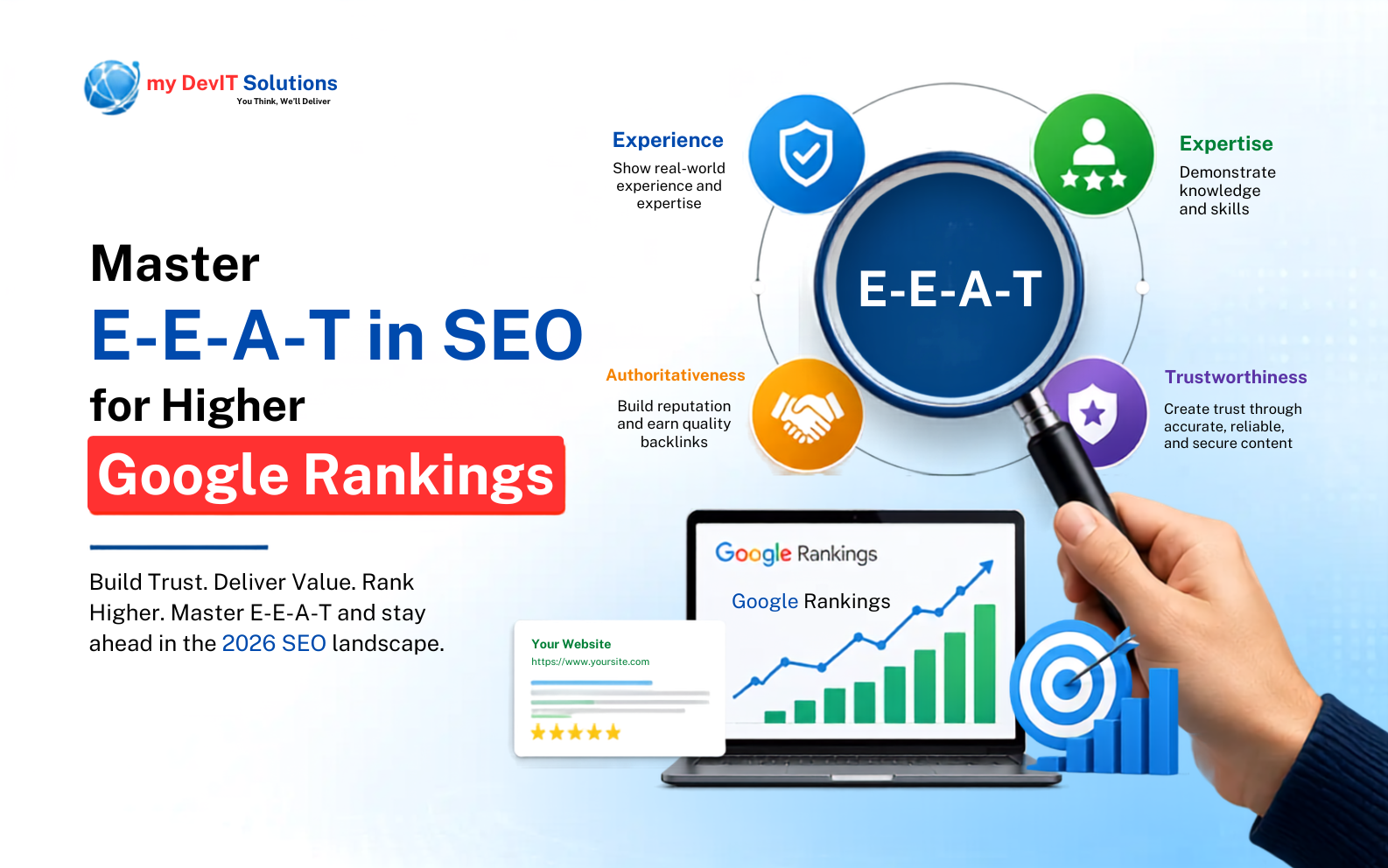
You cannot build genuine topical authority SEO without simultaneously building E-E-A-T signals. Google’s Search Quality Evaluator Guidelines explicitly describe high-quality pages as those demonstrating clear expertise, lived experience, recognized authoritativeness, and verifiable trustworthiness.
- Practical ways to embed E-E-A-T into your topical authority strategy:
- Assign articles to credentialed authors and display detailed author bios
- Cite peer-reviewed research, government data, and industry reports
- Include original insights, case studies, or first-hand experience
- Display clear editorial review dates on every published page
- Implement schema markup (Article, FAQ, HowTo, Person) to help Google parse expertise signals
- Build a transparent “About” page that establishes your organization’s credentials
- Collect and display authentic user reviews and testimonials
When E-E-A-T signals and topical depth work together, they create an authority flywheel: more trust → more clicks → better engagement signals → higher rankings → even more trust.
Conclusion
Understanding what is topical authority is only the beginning the real competitive advantage lies in executing a disciplined, cluster-based content strategy over time. In a search landscape where Google’s Algorithms are increasingly capable of evaluating genuine subject-matter depth, the sites that win are those that commit to being the authoritative resource in their niche, not just another page that contains the right keywords.
Whether you’re a startup building your first content strategy or an established brand looking to strengthen your organic presence, building topical authority in SEO offers the most durable, compounding returns of any digital channel. By following the pillar-cluster model, embedding E-E-A-T at every layer, and publishing with consistency and depth, your site can begin earning the kind of trust that Google and real human readers reward.
At my DevIT Solutions, we help businesses architect and execute topical authority strategies that are grounded in real data, aligned with the latest Google algorithm guidance, and built to generate sustainable organic growth. Ready to build topical authority that actually ranks? Let’s get started.
FAQs
Topical authority means your website is recognized by Google as a comprehensive, trustworthy expert on a specific subject, earned by publishing deep, interlinked content across all aspects of that topic.
Domain authority measures overall link popularity of a website, while topical authority measures how thoroughly and expertly a site covers a specific subject area a smaller site can outrank a high-DA site by having stronger topical authority.
There’s no fixed number, but most SEO professionals recommend building a cluster of at least 15–20 high-quality articles per core topic to begin establishing meaningful topical signals with Google.
Yes — once Google establishes your site as a topical authority in a niche, new content you publish within that topic cluster tends to rank significantly faster than it would on a site without that established authority signal.
Absolutely in fact, new websites that focus tightly on a niche and publish consistent, high-quality cluster content often build topical authority faster than older sites that have diluted their content across many unrelated topics.
Internal links connect your cluster articles to each other and to your pillar page, helping Google understand the hierarchy and relationships within your topic, which distributes authority signals across the entire cluster.
Yes local businesses can build topical authority by creating in-depth content about their service area, industry-specific topics, and local community subjects, which strengthens both their local and organic rankings.
Tools like Ahrefs (Topical Authority score), Semrush (Authority Score + topic research), Surfer SEO, and Koala AI all provide insights into topical coverage gaps and semantic optimization opportunities.