


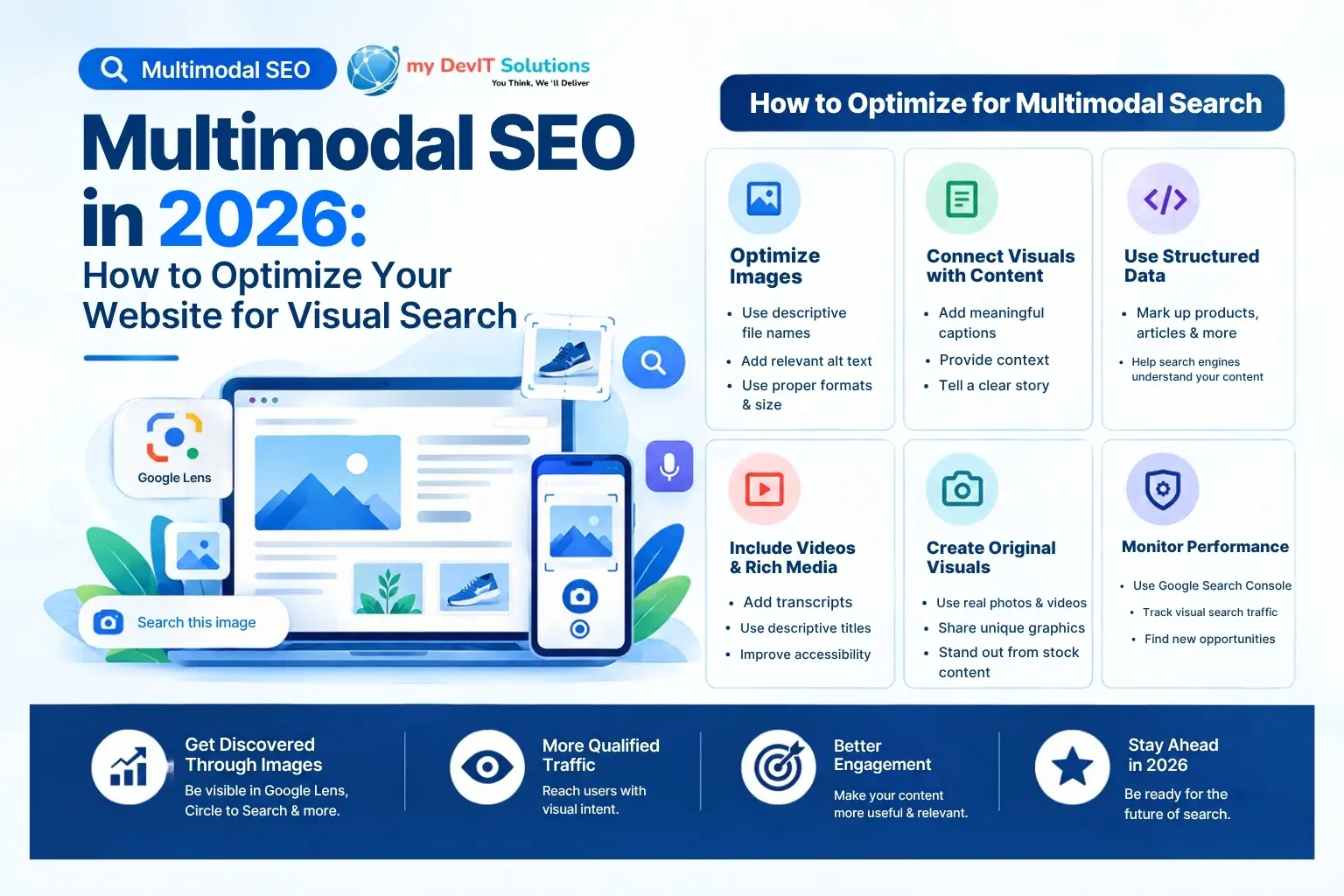
Search is no longer limited to typing keywords into Google.
People can now search using images, screenshots, smartphone cameras, voice, and combinations of text and visuals. Google is continuing to expand this type of search, making visual information an increasingly important part of how websites can be discovered.
This shift has created a new opportunity for businesses: multimodal SEO.
Multimodal SEO focuses on making your website easier for search systems to understand when users search through images, visual objects, screenshots, or mixed text-and-image queries.
In September 2026, Google introduced new Search Console reporting for web multimodal search. The reporting includes searches involving Google Lens, Circle to Search on Android, image uploads to Google Search, and Chrome’s “Search this image” feature.
That makes visual search something website owners can now monitor more directly.
What Is Multimodal SEO?
Multimodal SEO is the process of optimizing your website’s content so search engines and AI-powered search experiences can understand information presented through multiple formats.
Traditional SEO might focus on:
- Keywords
- Written content
- Page titles
- Internal links
- Backlinks
Multimodal SEO expands this approach to include:
- Images
- Image descriptions
- Videos
- Product visuals
- Structured data
- Context surrounding visual content
- Text and image relationships
The goal isn’t simply to add more images. It is to make every visual element meaningful, understandable, and connected to the surrounding content.
Why Visual Search Matters in 2026
Search behavior is becoming increasingly visual.
Google’s search experience now includes AI-powered features alongside traditional results, while tools such as Lens and Circle to Search allow people to start searches from things they see rather than things they type.
Google has also stated that AI Mode is becoming a major part of its Search experience, with users asking longer and more complex questions.
This means businesses should think beyond traditional keyword rankings.
A customer might see a product, building, clothing item, piece of furniture, or location and use their phone camera to discover what it is. If your website provides useful visual and textual information about that subject, it has an opportunity to become part of that discovery journey.
5 Ways to Improve Your Multimodal SEO
1. Use Descriptive Image File Names
Avoid uploading images with names such as:
IMG_4582.jpg
Instead, use descriptive names that explain the subject:
modern-wordpress-website-design.jpg
The filename should accurately describe the image rather than being stuffed with keywords.
2. Write Useful Alt Text
Alt text remains important for accessibility and helps provide additional context about an image.
For example, instead of:
website image
use something more descriptive:
responsive WordPress website displayed on desktop and mobile screens
Don’t turn alt text into a list of keywords. Describe what is actually visible.
3. Connect Images With Relevant Content
An image becomes more useful when the surrounding page explains it.
For example, if you’re publishing an article about website performance, don’t simply place an image of a fast website on the page.
Explain what the image demonstrates and connect it to the surrounding section.
This gives search systems additional context for understanding the relationship between the visual and the written content.
4. Use Structured Data Where Appropriate
Structured data can help Google better understand specific types of content.
Depending on your website, this may include information associated with products, articles, organizations, events, or other supported content types.
Google’s documentation explains that structured data can help its systems understand page content and potentially enable richer search appearances.
Structured data isn’t a shortcut to rankings, but accurate implementation can make your content easier for search engines to interpret.
5. Create Original Visual Content
Stock images are easy to find, which also means they provide limited differentiation.
Original screenshots, product photography, diagrams, charts, demonstrations, and branded visuals can give your website information that isn’t available everywhere else.
This is particularly useful as AI-powered search increasingly looks for content that provides genuine information and distinctive perspectives.
Google’s current guidance for generative search also emphasizes useful, non-commodity content rather than relying on special “AI SEO” tricks.
How to Measure Multimodal SEO
One of the biggest changes in 2026 is that Google is making visual-search performance easier to investigate.
The new multimodal search reporting in Search Console can show data associated with visual search experiences, including Lens, Circle to Search, image uploads, and other image-based searches.
Instead of only asking:
“What position does my keyword have?”
businesses can increasingly ask:
- Are people discovering my content through images?
- Which visual assets generate impressions?
- Which pages appear in multimodal searches?
- Are image searches bringing qualified visitors?
- Which visual topics should I create more content around?
These questions provide a broader picture of organic visibility.
The Future of SEO Is Becoming More Visual
Multimodal SEO doesn’t replace traditional SEO. It expands it.
Google continues to emphasize that established SEO fundamentals remain relevant even as generative search experiences evolve.
For businesses, the practical approach is straightforward: create useful pages, make images understandable, provide original information, connect visuals with relevant text, and monitor how people discover your content.
Search is becoming less about one box and one list of blue links.
The next search opportunity might begin with a camera, screenshot, image, or combination of visual and text-based information.
Businesses that prepare their websites for these experiences now can build a stronger foundation for how people discover information online in 2026 and beyond.