

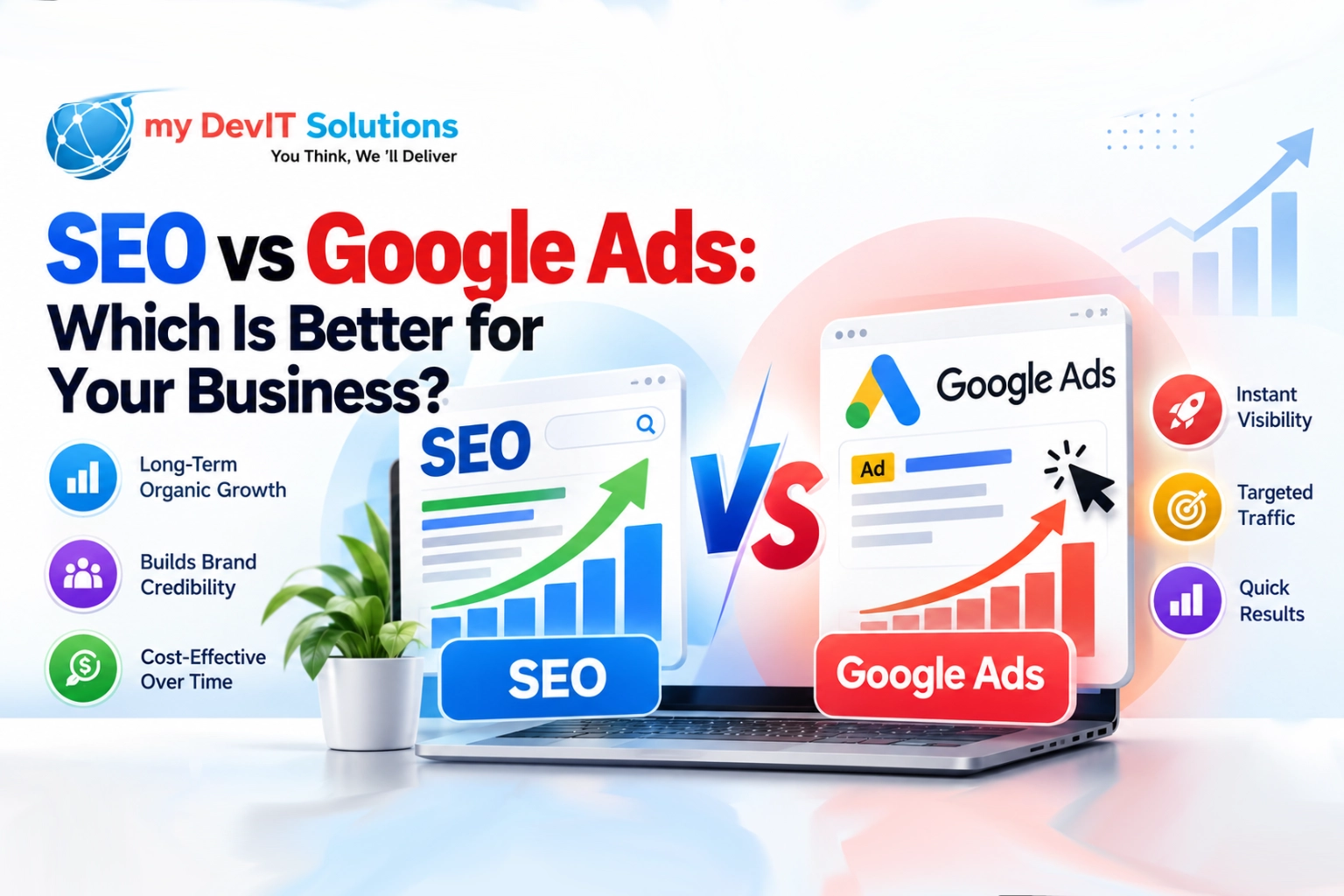
Every business owner eventually asks the same question: should I invest in organic rankings or pay for every click? At My Devit Solutions, we hear this almost weekly. The honest answer in the SEO vs Google Ads debate is that it depends on your goals, budget, and timeline. This guide covers SEO vs Google Ads cost, key differences, benefits, and which option fits small businesses, using the latest Google search developments.
SEO vs Google Ads: The Basics Explained
SEO (Search Engine Optimization) earns free, organic visibility by improving your website’s content, technical health, and authority. You don’t pay Google when someone clicks your listing, but you invest time, expertise, and content.
Google Ads is a paid platform where you bid on keywords. Your ad appears at the top of search results, and you typically pay each time someone clicks (pay-per-click, or PPC).
The difference is ownership versus rental. SEO builds an asset that keeps working for you. Google Ads rents attention that disappears the moment your budget stops.
Why Businesses Compare SEO vs Google Ads
Both channels target people actively searching for what you sell, which makes them high-intent traffic sources. Because budgets are limited, most businesses must decide where the first rupee or dollar goes. That is why the SEO vs Google Ads comparison matters so much for growth planning. If you need expert help building organic visibility, our local SEO Services are designed to deliver sustainable rankings.
SEO vs Google Ads Differences at a Glance
Understanding the SEO vs Google Ads differences helps you avoid expensive mistakes. Here is a side-by-side view:
| Factor | SEO | Google Ads |
|---|---|---|
| Traffic type | Organic (unpaid) | Paid |
| Time to results | 3–6+ months | Hours to days |
| Cost per click | None | Pay on every click |
| Longevity | Long-term, compounding | Stops when budget stops |
| Trust factor | High (earned ranking) | Moderate (labeled “Sponsored”) |
| Click-through behavior | Many users prefer organic results | Strong for commercial intent |
| Scalability | Gradual | Instant, budget-driven |
| Control | Limited (algorithm-based) | High (targeting, bids, schedules) |
The takeaway is that SEO is a slow-burn investment, while Google Ads is a fast-acting switch.
SEO vs Google Ads Cost: What Will You Actually Pay?
Cost is usually the deciding factor, so let’s be realistic. The SEO vs Google Ads cost gap is less about “cheap versus expensive” and more about how you pay. With SEO, you pay for strategy, content, technical fixes, and link-building, usually as a monthly retainer or project fee. With Google Ads, you pay Google directly for clicks, plus any agency management fee. Click costs vary widely by industry and competition. Legal, finance, and real estate keywords are often far pricier than local service keywords.
| Cost Element | SEO | Google Ads |
|---|---|---|
| Upfront setup | Audit, technical fixes, content plan | Account setup, landing pages |
| Ongoing cost | Monthly retainer or content spend | Daily or monthly ad budget plus management |
| Cost model | Fixed or project-based | Variable, per click |
| Cost trend over time | Decreases per lead as rankings grow | Stays consistent or rises with competition |
| Typical payback | Slower but compounding | Faster but non-compounding |
Note: actual pricing depends on your industry, location, and competitors, so treat any benchmark as a starting point and not a guarantee.
For a clearer picture of spend and returns, our Google Ads management team can model both channels against your lead targets.
Benefits of SEO vs Google Ads
Looking at the benefits of SEO vs Google Ads separately shows where each channel shines.
Benefits of SEO
- Compounding returns: a page that ranks today can bring leads for years.
- Lower long-term cost per lead: you aren’t paying for each click.
- Credibility: users tend to trust organic listings.
- Brand authority: quality content positions you as an expert.
- AI search visibility: strong, trusted content is more likely to be surfaced in AI-generated answers.
Benefits of Google Ads
- Immediate visibility: launch a campaign and appear on page one quickly.
- Precise targeting: choose location, device, time, audience, and intent.
- Measurable ROI: track every click, call, and conversion.
- Easy testing: try offers, headlines, and landing pages fast.
- Scalable growth: raise the budget when demand rises.
Neither list is “better” in isolation. The right pick depends on what you need right now.
SEO vs Google Ads for Small Business
For owners with tight budgets, the question of SEO vs Google Ads for small business is practical, not theoretical. Small businesses can’t afford wasted spend, so the strategy should match the stage of the company.
| Business Situation | Recommended Priority | Why |
|---|---|---|
| Brand-new website, need leads now | Google Ads first | Fast traffic while SEO builds |
| Local service business (plumber, clinic, salon) | SEO plus local optimization | Strong local intent, lower long-term cost |
| Limited monthly budget | SEO-led, small Ads test | Builds a lasting asset |
| Seasonal offer or sale | Google Ads | Time-bound demand |
| Competitive, high-CPC niche | SEO focus | Reduces dependence on costly clicks |
| Established site with good traffic | Both | Ads capture bottom-funnel, SEO builds authority |
A smart small-business approach is to start with a modest Google Ads campaign for quick data and revenue, while investing steadily in SEO. As organic rankings grow, you can reduce paid spend on keywords you already own. If your website needs a conversion-friendly foundation first, our website design services can help.
SEO vs PPC: Which Is Better?
So, in the SEO vs PPC debate, which is better? Neither wins universally:
- Choose SEO if you can wait 3–6 months, want lower long-term costs, and plan to stay in business for years.
- Choose PPC if you need leads immediately, are launching a new product, or are testing a market.
- Choose both if you want the strongest results. PPC supplies fast data on which keywords convert, and SEO then targets those proven keywords for lasting traffic.
At My Devit Solutions, we usually recommend this blended model because it balances speed with sustainability.
How Google’s Latest Updates Affect SEO vs Google Ads
Search is changing quickly, and your decision should reflect that. Google’s May 2026 Core Update began rolling out on May 21, 2026, and was the second broad core update of the year. Google confirmed on its Search Status Dashboard that the rollout was completed on June 2, 2026.
AI-driven search is also growing. Google I/O confirmed that AI Mode has passed one billion monthly users, with queries more than doubling every quarter. The practical lesson is that Google’s AI features draw on the same index SEO has always targeted, so helpful, trustworthy content matters more than ever. Google also notes that structured data isn’t required for AI features specifically, but it remains a smart part of an overall SEO strategy.
| Trend | Impact on SEO | Impact on Google Ads |
|---|---|---|
| Core updates | Reward helpful, original, expert content | Little direct effect, but landing page quality still matters |
| AI Overviews and AI Mode | Trusted content can be cited; clicks may shift | Ads continue to appear alongside AI results |
| Spam and scaled-content crackdowns | Thin or mass-produced content is risky | Not affected |
| Rising competition for clicks | Pushes brands toward authority building | CPCs may rise as advertisers compete |
If impressions hold steady while clicks fall, that can point to AI features absorbing some clicks and not necessarily a ranking penalty. This is one more reason to diversify beyond a single channel. Pairing both channels with strong content marketing keeps you visible wherever people search.
Is SEO Better Than Google Ads?
SEO is generally better for long-term growth, trust, and lower cost per lead. Google Ads is better for speed, control, and short-term campaigns. For most businesses, especially small ones, the smartest answer to SEO vs Google Ads isn’t “either/or” but “which first, and how to combine them.”
Conclusion
The SEO vs Google Ads decision comes down to timing, budget, and goals. If you need leads this week, Google Ads delivers. If you want a dependable growth engine that gets cheaper over time, SEO is the stronger investment. Brands that combine both, using paid data to guide organic strategy, tend to see the most resilient results as Google’s algorithms and AI features keep evolving. Ready to build the right mix for your business? My Devit Solutions can audit your website, analyze your competitors, and design a custom SEO and Google Ads plan that fits your budget. Contact us today to get started.
SEO is usually better for long-term, low-cost growth, while Google Ads is better for quick leads, so many small businesses benefit from using both.
SEO typically takes 3–6 months or more to show strong results, while Google Ads can generate traffic within hours of launching.
SEO earns free organic traffic over time, while Google Ads buys paid placement and stops delivering traffic when you stop paying.
SEO is generally cheaper over the long term because organic rankings keep bringing traffic without per-click fees.
Yes, running both lets Google Ads give you fast data and leads while SEO builds lasting organic visibility.
Core updates mainly affect organic rankings, not ad auctions, though landing page quality still influences ad performance.
My Devit Solutions offers audits, strategy, SEO, and Google Ads management tailored to your goals and budget.