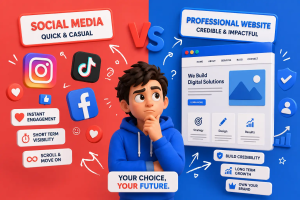


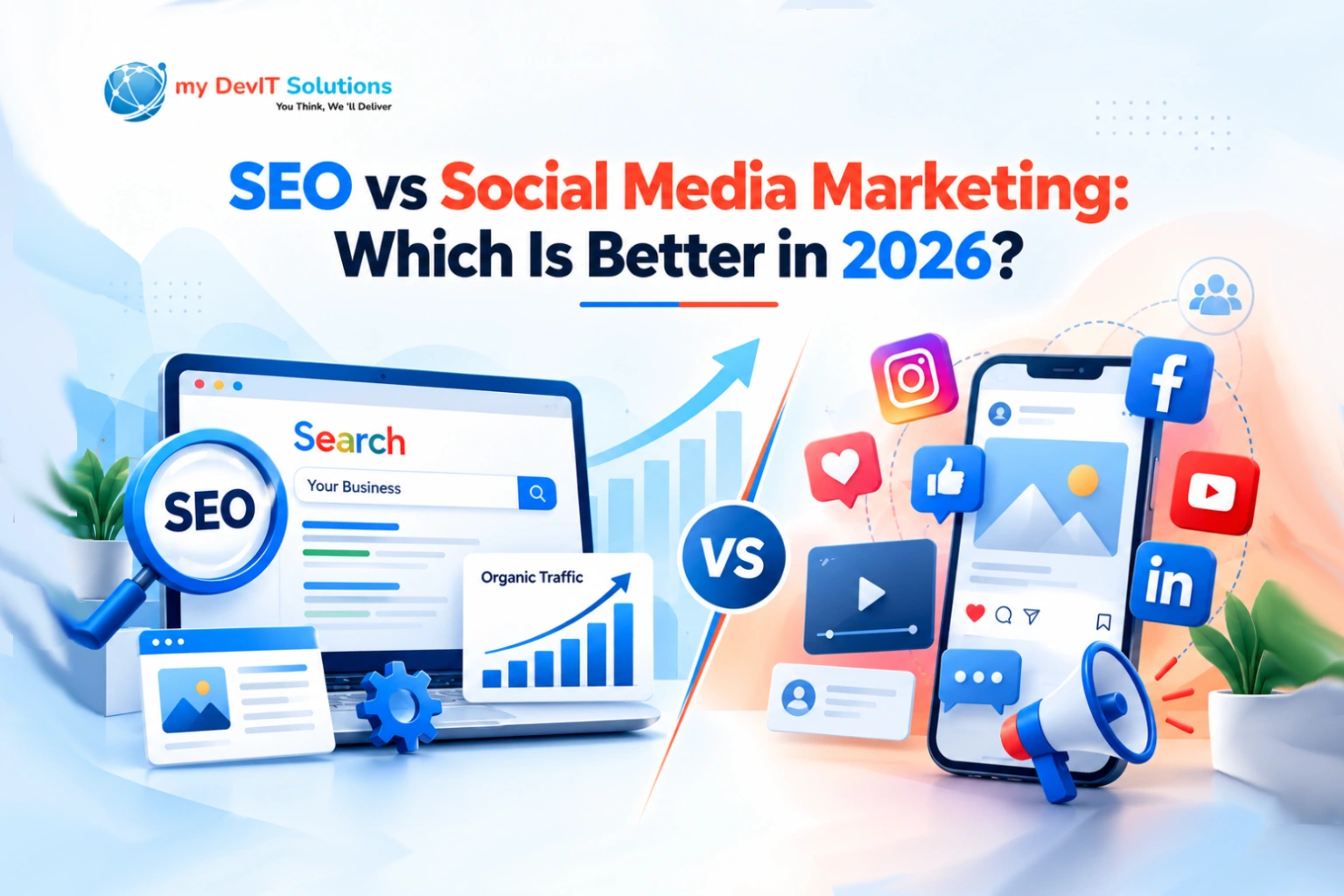
Choosing the right digital marketing strategy can help businesses attract customers, build brand awareness, and increase revenue. In 2026, My Devit Solutions helps businesses understand how search engine optimization and social media marketing can strengthen their online presence. But when comparing SEO vs Social Media Marketing, which strategy delivers better results? SEO helps people discover websites through search engines, while social media marketing connects businesses with audiences through engaging content, conversations, and campaigns. Understanding the advantages, limitations, and costs of both channels can help businesses create a smarter marketing strategy and achieve sustainable growth.
What Is SEO vs Social Media Marketing?
Search engine optimization (SEO) improves a website’s visibility in organic search results. It includes keyword research, technical optimization, useful content, internal linking, mobile usability, and website performance improvements. Social media marketing focuses on promoting a brand through platforms such as Facebook, Instagram, LinkedIn, TikTok, and YouTube. Businesses use posts, videos, stories, community engagement, and paid advertising to reach potential customers.
The difference between seo and social media marketing is primarily how audiences discover and interact with a business. Someone searching for a web development company may already need a service, while someone scrolling through Instagram may discover a business for the first time. SEO helps capture existing search demand, whereas social media can introduce a business to people who have not started actively searching.
SEO vs Social Media Marketing: Key Differences
| Factor | SEO | Social Media Marketing |
|---|---|---|
| Main objective | Improve organic search visibility | Increase brand awareness and engagement |
| Audience intent | Often actively searching | Often discovering or exploring |
| Content formats | Blogs, landing pages, guides | Posts, videos, stories, carousels |
| Results timeline | Usually gradual | Paid campaigns can start quickly; organic reach varies |
| Long-term potential | Pages can continue attracting search traffic | Content may continue generating engagement |
| Main metrics | Organic clicks, leads, conversions | Reach, engagement, referrals, conversions |
| Advertising costs | No payment per organic click, but SEO requires investment | Organic posting is possible; paid campaigns require budget |
Neither strategy guarantees traffic or sales. Results depend on competition, audience needs, content quality, execution, and the effectiveness of the conversion process.
What Are the Benefits of SEO in 2026?
SEO is important for businesses that want to attract people actively searching for information, products, or professional services.
1. Attract Customers With Clear Search Intent
Customers frequently use Google to compare service providers, research solutions, and investigate products before making decisions. For example, someone searching for “WordPress development company” may already be looking for a developer. A well-optimized service page explaining the company’s expertise, project process, and capabilities can help that potential customer evaluate the business. SEO also helps businesses address specific questions through informative articles, comparison pages, and service guides. These resources can support customers throughout their decision-making process.
2. Build Long-Term Organic Visibility
Unlike paid advertisements that depend on advertising spend for continued paid exposure, useful SEO content can continue attracting visitors after publication. However, rankings are not guaranteed, and pages may need updating as competitors, customer expectations, and search results change. Technical SEO is equally important. Search engines need to access, crawl, and understand important pages. Clear navigation, relevant internal links, mobile usability, and appropriate page structure help create a more accessible website. Businesses investing in SEO Services should focus on technical health, valuable content, search intent, and measurable business outcomes rather than rankings alone.
3. Prepare for AI-Powered Search
Google’s search experience includes AI-powered features such as AI Overviews and AI Mode. Its official AI search guidance explains that established SEO practices remain relevant to these experiences. Businesses should create original, accurate, useful content that answers customer questions clearly. There is no guaranteed shortcut for appearing in AI-generated search responses. Google’s people-first content guidance emphasizes original value, reliability, and satisfying the audience’s needs rather than producing content primarily to manipulate rankings.
What Are the Benefits of Social Media Marketing in 2026?
Social media marketing helps businesses introduce their offerings, communicate directly with audiences, and distribute content in engaging formats.
1. Increase Brand Awareness
Social platforms can expose your business to people who may not know your brand. Educational posts, short videos, project demonstrations, and behind-the-scenes content can explain complicated services in an accessible way. For example, a web development agency might publish a website redesign, share WordPress maintenance tips, or explain how responsive layouts improve mobile usability.
2. Build Customer Relationships
Social media enables businesses to answer questions, respond to comments, share updates, and participate in industry conversations. Consistent, helpful interactions can make a brand more recognizable and approachable. However, publishing frequently is not enough. Content should provide meaningful information, reflect the company’s expertise, and encourage relevant conversations.
3. Test Advertising Campaigns
Paid social campaigns allow businesses to reach audiences using the targeting options available on each platform. Companies can test different messages, creative formats, and offers to identify which combinations generate qualified leads. Organic posting and paid advertising have different purposes. Organic content supports continuing engagement, while paid campaigns can expand reach within a defined budget.
SEO vs Social Media: Which Is Better for Different Business Goals?
The ideal strategy depends on the business, audience, competition, and customer journey.
| Business goal | SEO approach | Social media approach |
|---|---|---|
| Generate service inquiries | Optimize relevant service pages | Share useful content and case studies |
| Build brand awareness | Publish informative resources | Share videos and engaging posts |
| Launch a product | Create product and comparison pages | Promote launch content and offers |
| Generate B2B leads | Publish detailed industry guides | Share professional insights on LinkedIn |
| Grow an online store | Optimize product pages and categories | Demonstrate products through visual content |
| Reach local customers | Improve relevant local pages and eligible Google Business Profile listings | Share local news and community content |
A company should select channels according to customer behavior rather than assuming one strategy will outperform the other in every situation.
SEO or Social Media Marketing Which Is Better for Small Businesses?
The question seo or social media marketing which is better depends on how customers discover and evaluate your services. A plumber, law firm, or web development agency may benefit from SEO because customers often search for a particular service when they need assistance. A restaurant, fashion brand, or visually driven business may benefit from social media because images and videos help potential customers discover its offerings.
Both channels can work together. SEO can attract people looking for a solution, while social media can demonstrate expertise and maintain customer relationships. A strong website supports both strategies. Investing in Website Development can help businesses create responsive pages, clear service information, useful navigation, and conversion-focused calls to action.
SEO vs Social Media Marketing: Which Delivers Better ROI?
Return on investment (ROI) measures the value generated relative to the cost of a marketing activity. Neither SEO nor social media guarantees a better return for every business. SEO investment can include content creation, technical improvements, research, and specialist support. Social media expenses may include content production, creative design, management, and advertising. SEO often requires patience, while paid campaigns can generate exposure more quickly. However, fast traffic does not automatically mean profitable leads.
Performance Metrics Businesses Should Track
| SEO metrics | Social media metrics |
|---|---|
| Organic clicks and impressions | Reach and impressions |
| Search query performance | Engagement and video views |
| Organic leads and conversion rate | Qualified leads and conversions |
| Organic cost per lead | Paid cost per lead |
| Revenue attributed to organic search | Revenue attributed to social campaigns |
Businesses should measure actual outcomes rather than focusing only on rankings, views, likes, or followers. For example, a social campaign that generates 100 inquiries may be less profitable than SEO that generates 25 qualified leads if those organic leads convert more frequently and produce greater revenue. Use analytics and conversion tracking to understand where leads originate. Because customers may discover a business on social media and later return through Google, evaluate the full customer journey rather than relying exclusively on the last click.
How Website Development and Web App Development Support Marketing
Marketing performance depends partly on what happens after visitors arrive. A website that is confusing, difficult to navigate, or unclear about its offerings can lose potential customers regardless of the traffic source. Professional Website Development establishes the technical and visual foundation of a business’s online presence. Responsive layouts, accessible navigation, useful information, and clear calls to action help visitors understand services and take the next step.
Businesses requiring more advanced functionality may also benefit from Web App Development. Custom web applications can support booking systems, customer portals, online accounts, interactive tools, and specialized business processes. Not every business needs a custom application. The decision should consider actual requirements, implementation costs, security, usability, and expected business value. When SEO and social media direct visitors to a useful digital experience, businesses have more opportunities to turn interest into inquiries, subscriptions, or sales.
How Google Algorithm Updates Affect SEO in 2026
Google regularly improves its ranking systems to provide relevant and useful search results. Businesses should avoid relying on a single optimization trick or assuming that every algorithm update requires a complete strategy change. Important practices include creating original content, using descriptive titles and headings, improving technical accessibility, maintaining mobile usability, and addressing real customer questions.
Google’s Search spam policies address practices such as keyword stuffing and link spam. Repeating keywords unnaturally or building links primarily to manipulate rankings can put a website at risk. For SEO vs Social Media Marketing, a sustainable strategy focuses on helping customers, building a trustworthy online presence, and measuring the results of marketing activities.
Digital Marketing: How to Combine SEO and Social Media
A connected Digital Marketing strategy can coordinate organic search, social content, paid advertising, and conversion optimization. Consider a web development company publishing a detailed article about website speed. It can optimize the article for relevant search queries, share key insights on LinkedIn, create an educational video, and guide interested users to a relevant service page.
Social engagement may reveal customer questions that deserve a more detailed article. Search data can also identify topics worth repurposing into videos and social posts. This creates a coordinated marketing process instead of treating every channel independently. Businesses should still track channel-specific performance to understand what contributes to traffic, qualified leads, and revenue. My Devit Solutions offers website development, web application development, SEO, and digital marketing services that businesses can evaluate according to their growth objectives, customer needs, and available resources.
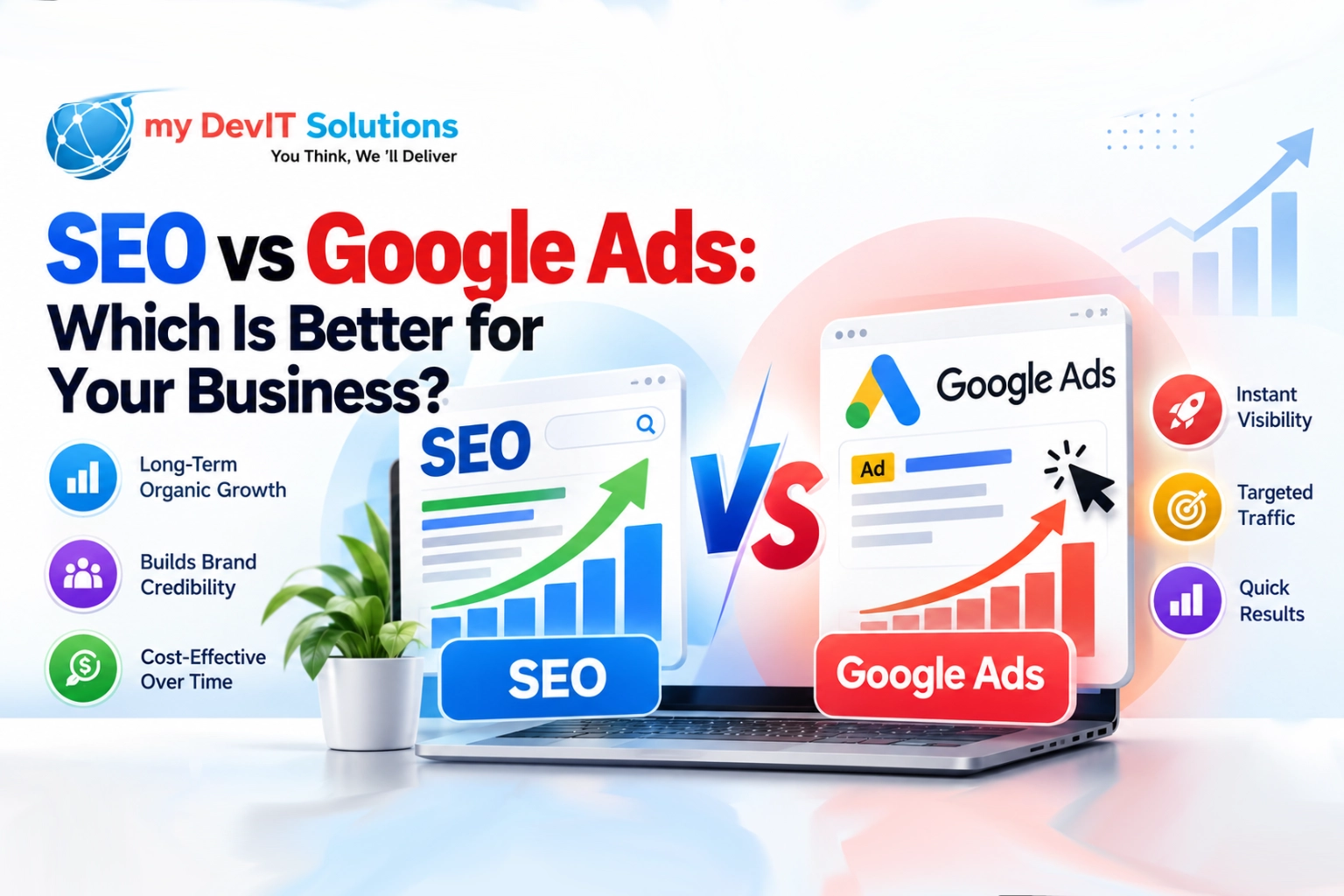
Is SEO Better Than Google Ads?
The question Is SEO Better Than Google Ads involves two different marketing approaches. SEO focuses on organic search visibility, while Google Ads provides paid placements through advertising campaigns. SEO can support long-term organic discovery, whereas Google Ads can help businesses reach relevant searchers more quickly when campaigns are configured and funded appropriately.
Neither approach guarantees profitable results. Both require relevant landing pages, accurate messaging, conversion tracking, and ongoing optimization. Businesses can read the detailed comparison in Is SEO Better Than Google Ads? to understand the trade-offs between organic search and paid advertising. Some businesses benefit from using both: paid campaigns can provide early performance data, while SEO builds organic visibility over time. The right balance depends on search demand, competition, budget, and how quickly the company needs qualified leads.
Conclusion
When comparing SEO vs Social Media Marketing, the best choice depends on business objectives, customer behavior, budget, and timeline. SEO helps businesses reach users actively searching for relevant information or services, while social media supports brand discovery, audience engagement, and customer relationships.
Neither channel is universally superior. SEO can build continuing organic visibility, while social platforms offer opportunities to distribute content and communicate directly with audiences. Combining these channels with effective website development, useful content, and reliable analytics can create a more complete digital marketing strategy. My Devit Solutions helps businesses explore SEO and digital marketing services according to their online visibility, customer engagement, and lead-generation goals. Focus on qualified traffic, a useful customer experience, and measurable business outcomes rather than vanity metrics or guaranteed ranking promises.
FAQs
SEO earns organic traffic from search engines, while social media marketing builds audience and engagement on social platforms.
SEO is better for long-term, high-intent leads, and social media is better for fast awareness, so most businesses need both.
Only when tied to a goal, because the two channels serve different stages of the customer journey.
SEO is cheaper over time, while Google Ads is faster, so the best results usually come from using them together.
Not directly, but it builds brand searches, backlinks and traffic that support your authority.
SEO usually shows results in 4–9 months, while social media can deliver results within days.
Yes, speed, mobile usability and clean structure are the base of every ranking strategy.
Local SEO plus one or two social platforms usually gives small businesses the best return.