

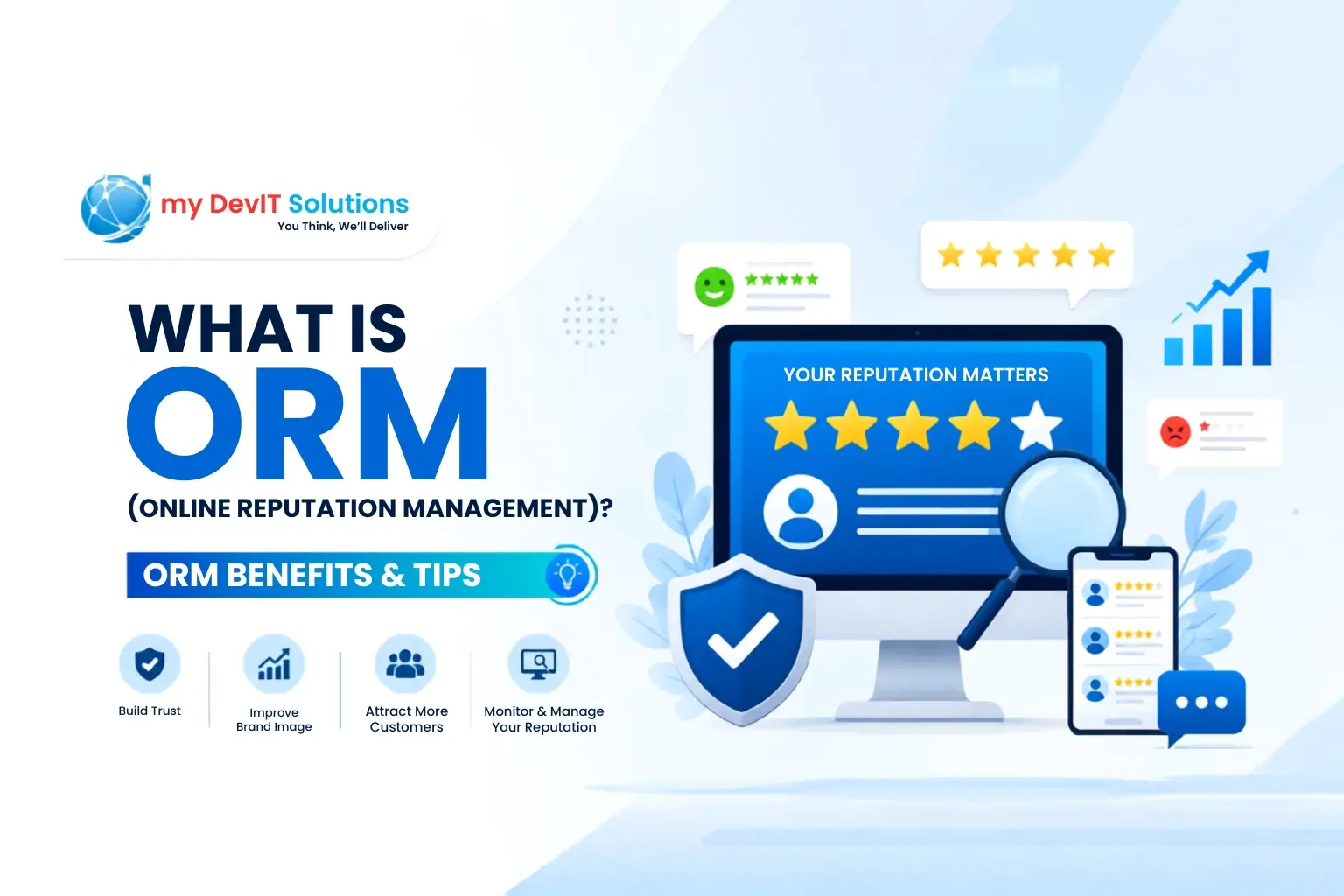
In today’s hyper-connected digital world, your online presence can make or break your business. At my DevIT Solutions, we understand that managing how your brand appears online is no longer optional it is a strategic necessity. What Is ORM (Online Reputation Management)? Simply put, it is the practice of monitoring, influencing, and controlling how your brand, business, or personal identity is perceived across the internet. From Google search results to social media platforms, review sites, and news articles, ORM ensures that the digital narrative surrounding you remains positive, credible, and competitive.
What Is ORM (Online Reputation Management)? A Complete Overview
Online Reputation Management (ORM) is a multidisciplinary digital strategy that combines SEO, content marketing, social media management, public relations, and customer service to shape and protect your brand’s image online. It involves proactively building a positive digital footprint while also addressing and suppressing negative content that may harm your credibility.
In 2026, Google’s algorithms including the Helpful Content Update (HCU), E-E-A-T guidelines, and the Page Experience signals place enormous weight on trustworthiness and authority. ORM directly feeds into these ranking factors, making it inseparable from modern digital marketing strategies.
Why ORM Matters More Than Ever in 2026
The numbers speak for themselves:
- 93% of consumers read online reviews before making a purchase decision.
- 87% of buyers won’t consider a business with low ratings.
- A single negative article on the first page of Google can cost a business up to 22% of its customers.
- Brands with strong ORM strategies see an average revenue increase of 5–9%.
These statistics highlight that what people find when they Google your name or business directly impacts your bottom line.
Key Components of Online Reputation Management
ORM is not a single tool or tactic it is a full ecosystem of strategies working together. Below is a breakdown of its core components:
| ORM Component | Description | Tools/Platforms |
|---|---|---|
| Review Monitoring | Track and respond to reviews on Google, Yelp, Trustpilot, etc. | Google Alerts, ReviewTrackers |
| Search Result Management | Push down negative links; promote positive content | SEO, Content Marketing |
| Social Media Listening | Monitor brand mentions across social platforms | Hootsuite, Mention, Brandwatch |
| Crisis Management | React swiftly to PR crises before they escalate | PR Strategies, Media Outreach |
| Content Publishing | Publish authoritative, positive content consistently | Blogs, Press Releases, Videos |
How ORM Works: Step-by-Step Process
Understanding what is ORM (Online Reputation Management) means understanding its workflow. Here is how a robust ORM strategy operates:
Step 1: Audit Your Current Online Presence
Begin by Googling your brand name, product names, and key executives. Identify what appears on the first three pages of search results both positive and negative. Tools like SEMrush, Ahrefs, and Google Search Console help you assess your digital footprint accurately.
Step 2: Monitor Brand Mentions Continuously
Set up real-time alerts using Google Alerts, Mention.com, or Brand24. Monitor all channels including forums, Reddit threads, social media, news sites, and industry blogs. The faster you detect a negative mention, the faster you can respond.
Step 3: Respond to Reviews Professionally
Whether positive or negative, respond to every review promptly and professionally. According to Google’s own guidelines, businesses that actively engage with reviews signal trustworthiness a core E-E-A-T factor that influences search rankings.
Step 4: Create and Promote Positive Content
Publish high-quality blog posts, case studies, press releases, client testimonials, and social media content that showcases your expertise and authority. This content competes for valuable real estate on search engine results pages (SERPs) and pushes negative results lower.
Step 5: Suppress Negative Content Through SEO
Working with experts in Best IT Consulting Services for Startups In USA can help build a comprehensive digital strategy that suppresses harmful content through ethical SEO and content marketing techniques.
ORM For SEO: How They Work Together
One of the most overlooked aspects of ORM for SEO is how deeply intertwined the two disciplines are. Google’s E-E-A-T framework (Experience, Expertise, Authoritativeness, Trustworthiness) is essentially the algorithmic representation of your online reputation.
Here is how ORM directly impacts SEO performance:
| ORM Activity | SEO Impact |
|---|---|
| Earning 5-star reviews on Google Business Profile | Improves local SEO rankings |
| Publishing authoritative thought-leadership content | Boosts domain authority and topical trust |
| Earning backlinks from reputable PR and news sites | Increases domain rating and SERP visibility |
| Removing or suppressing negative pages | Improves overall brand SERP landscape |
| Consistent NAP (Name, Address, Phone) data | Strengthens local SEO citations |
| Positive social signals and brand mentions | Indirect ranking factor for brand authority |
This relationship between ORM and SEO means that brands investing in reputation management simultaneously improve their organic search performance a double win for digital growth.
Benefits of Online Reputation Management
Understanding the benefits of best online reputation management goes beyond just protecting your image. It delivers measurable business results.
1. Increased Customer Trust and Confidence
Consumers trust brands that have consistent, positive online reviews and a professional digital presence. A well-managed reputation signals credibility, which converts visitors into paying customers.
2. Higher Search Engine Rankings
As discussed in the ORM for SEO section, Google rewards trustworthy brands. ORM activities like review generation, authoritative content publishing, and link earning directly improve your positions in organic search results.
3. Competitive Advantage
In competitive markets, your online reputation can be the deciding factor for a potential customer choosing you over a rival. Brands with clean, authoritative digital footprints consistently outperform competitors with poor or unmanaged reputations.
4. Crisis Prevention and Damage Control
Proactive ORM allows you to detect and address potential PR crises before they snowball. Early intervention responding to a negative review, correcting false information, or issuing a public statement can prevent significant revenue loss.
5. Better Talent Acquisition
Job seekers research companies before applying. A positive online reputation helps you attract top-tier talent, reducing hiring costs and improving team quality.
A professionally designed digital presence also plays a crucial role here. Businesses leveraging Top Rated Website Design & Development Services in USA ensure their owned web properties project credibility and professionalism at every touchpoint.
Best Online Reputation Management Services for Individuals
ORM is not exclusive to corporations. Best online reputation management services for individuals including executives, entrepreneurs, doctors, lawyers, and public figures have become a critical personal branding tool.
What Individual ORM Covers:
- Personal SERP Management: Controlling what appears when someone Googles your name.
- Social Media Cleanup: Removing or updating outdated or inappropriate posts.
- Thought Leadership Building: Publishing LinkedIn articles, guest posts, and speaking engagements to build a positive digital persona.
- Negative Content Removal: Legally requesting removal of defamatory, false, or privacy-violating content.
- Wikipedia and Knowledge Panel Management: Ensuring accurate information appears in Google’s knowledge graph.
For individuals in highly competitive fields, proactive ORM can be the difference between landing a partnership deal, securing funding, or winning a high-value client.
| Individual ORM Strategy | Goal | Timeline |
|---|---|---|
| LinkedIn Optimization | Build professional authority | 1–3 months |
| Guest Blogging on Authority Sites | Push personal brand content to page 1 | 3–6 months |
| Online Profile Completeness | Control SERP results for your name | 1–2 months |
| Negative Review Response | Mitigate damage from poor reviews | Immediate |
| Press Release Distribution | Generate positive coverage | 1–4 weeks |
Best Online Reputation Management in USA: What to Look For
If you are searching for the best online reputation management in USA, it is important to choose a provider that offers a comprehensive, ethical, and transparent approach. Here are the criteria that distinguish top-tier ORM agencies:
1. White-Hat SEO Practices
Avoid agencies that promise overnight results using black-hat techniques like fake reviews or manipulated backlinks. These tactics violate Google’s policies and can result in severe penalties.
2. Transparent Reporting
Top ORM providers deliver detailed monthly reports covering review trends, SERP changes, sentiment analysis, and content performance.
3. Industry Experience
Look for agencies with proven case studies in your specific industry. Reputation challenges vary significantly between healthcare, law, e-commerce, and hospitality.
4. Integrated Digital Services
The most effective ORM strategies integrate seamlessly with your broader digital marketing including web design, SEO, and content marketing. Companies that offer Best Website Design Development and SEO Services in USA ensure every digital touchpoint reinforces a positive brand image.
5. Crisis Response Capability
Ensure your ORM partner has a clear crisis management protocol with dedicated response teams, media relations capabilities, and legal consultation access.
ORM Tips: Proven Strategies to Manage Your Online Reputation
Here are actionable ORM tips backed by current best practices and Google’s 2026 algorithm guidelines:
Tip 1: Claim and Optimize All Business Profiles
Claim your Google Business Profile, Yelp, Bing Places, and industry-specific directories. Keep all information accurate, consistent, and up to date. This directly influences your local SEO and ORM simultaneously.
Tip 2: Proactively Solicit Positive Reviews
After a successful customer interaction, send follow-up emails requesting honest reviews. Make the process as simple as possible with direct links to your Google review page. Organic, authentic reviews are the backbone of ORM success.
Tip 3: Publish E-E-A-T Content Regularly
Google’s Helpful Content System (2023–2026) rewards content that demonstrates genuine experience and expertise. Publish in-depth guides, case studies, data-driven reports, and expert interviews that position you as an authority.
Tip 4: Engage on Social Media Consistently
Social media profiles rank in Google search results. An active, professional social media presence responding to comments, sharing industry insights, and showcasing achievements strengthens your ORM significantly.
Tip 5: Monitor and Address Negative Content Quickly
Speed matters in ORM. Set up automated monitoring tools and establish internal escalation protocols so negative content is identified and addressed within 24–48 hours.
Tip 6: Understand How AI Affects Your Reputation
Search is rapidly evolving with AI-powered results. Understanding How SEO Is Affected By AI is now essential for ORM professionals, as AI Overviews and generative search results significantly impact brand visibility in Google Search.
Tip 7: Build High-Quality Backlinks to Positive Content
Earn backlinks from reputable news outlets, industry publications, and partner websites pointing to positive content about your brand. This increases the ranking strength of favorable pages, pushing them above negative results.
ORM vs. PR vs. SEO: Understanding the Differences
Many businesses confuse ORM with traditional PR or SEO. Here is a clear comparison:
| Factor | ORM | PR | SEO |
|---|---|---|---|
| Primary Goal | Manage online perception | Media coverage and relationships | Organic search visibility |
| Timeline | Ongoing | Campaign-based | Long-term (3–12 months) |
| Channels | All digital channels | Earned media, press | Search engines |
| Measurement | Sentiment, SERP landscape | Media mentions, reach | Rankings, traffic |
| Crisis Response | Yes — real time | Yes — planned | No |
| Review Management | Core function | Not typically | Indirect |
ORM sits at the intersection of all three disciplines, borrowing tools and tactics from each to create a holistic brand protection strategy.
The Role of Business Intelligence in ORM
Data-driven ORM strategies are far more effective than reactive, gut-feel approaches. Partnering with a Best Business Intelligence Consulting Company In USA allows businesses to leverage advanced analytics including sentiment analysis, competitor benchmarking, and predictive crisis detection to make smarter reputation management decisions.
Business Intelligence tools help ORM professionals:
- Identify emerging negative trends before they become crises
- Benchmark brand sentiment against competitors
- Track ROI of ORM campaigns with precision
- Predict customer churn based on sentiment signals
Common ORM Mistakes to Avoid
Even experienced marketers make critical ORM errors. Here are the most common pitfalls:
1. Ignoring Negative Reviews: Failing to respond to criticism signals indifference and worsens the perception of potential customers reading those reviews.
2. Fake Reviews: Generating fake positive reviews violates Google’s policies, FTC guidelines, and consumer trust. The penalties including de-indexing and legal action far outweigh any short-term benefits.
3. Reacting Emotionally to Criticism: Defensive or confrontational responses to negative reviews amplify the problem. Always respond professionally, empathetically, and solution-focused.
4. Neglecting Owned Media: Your website, blog, and social profiles are your most controllable ORM assets. Neglecting them leaves a vacuum that negative content will fill.
5. One-Time ORM Campaigns: ORM is not a project it is an ongoing program. Brands that treat it as a one-time fix quickly find their reputation eroding again.
Conclusion
What Is ORM (Online Reputation Management)? It is one of the most powerful competitive advantages available to modern businesses and individuals. In 2026, where Google’s algorithms are smarter, consumers are more informed, and information spreads faster than ever, proactive reputation management is the cornerstone of digital success.
From driving higher search rankings through ORM for SEO integration, to building unshakeable customer trust, to attracting top talent and protecting against PR crises the benefits of best online reputation management are comprehensive and measurable.
At my DevIT Solutions, we offer integrated digital solutions that align ORM with your broader business goals from web design and SEO to IT consulting and business intelligence. Whether you are a startup, a growing enterprise, or an individual professional, we help you take control of your digital narrative and build a reputation that drives real business growth.
Ready to protect and elevate your online reputation? Contact my DevIT Solutions today.
FAQs
ORM is the practice of monitoring, shaping, and controlling how your brand or personal identity appears across the internet, including search engines, social media, review sites, and news platforms.
Basic improvements like review responses and profile optimization show results within 1–4 weeks, while significant SERP changes typically take 3–6 months depending on the severity of the reputation issue.
No – ORM is equally important for small businesses, startups, individual professionals, and even job seekers who want to control what people find when they search for them online.
SEO focuses on improving search rankings for specific keywords, while ORM specifically manages the sentiment, content, and perception of your brand across all digital channels, including platforms SEO does not typically cover.
In some cases yes through legal removal requests (for defamatory or false content), Google’s removal tools (for personal information), or by suppressing content through stronger, positive SEO content ranking above it.
The best individual ORM strategy combines LinkedIn optimization, personal branding content, Google profile management, and proactive monitoring of your name across all digital channels.
Yes – actively managing Google Business Profile reviews, consistent business listings, and local content publishing are core ORM activities that directly improve local search rankings.
Common ORM tools include Google Alerts, SEMrush, Brandwatch, ReviewTrackers, Mention.com, Hootsuite, and Ahrefs for comprehensive monitoring and management.
ORM costs vary widely from a few hundred dollars per month for basic monitoring tools to several thousand for comprehensive agency-managed programs involving content, PR, and advanced SEO.
my DevIT Solutions offers an integrated approach combining ORM with SEO, web development, IT consulting, and business intelligence ensuring your reputation strategy aligns with and amplifies all your digital marketing efforts.Share