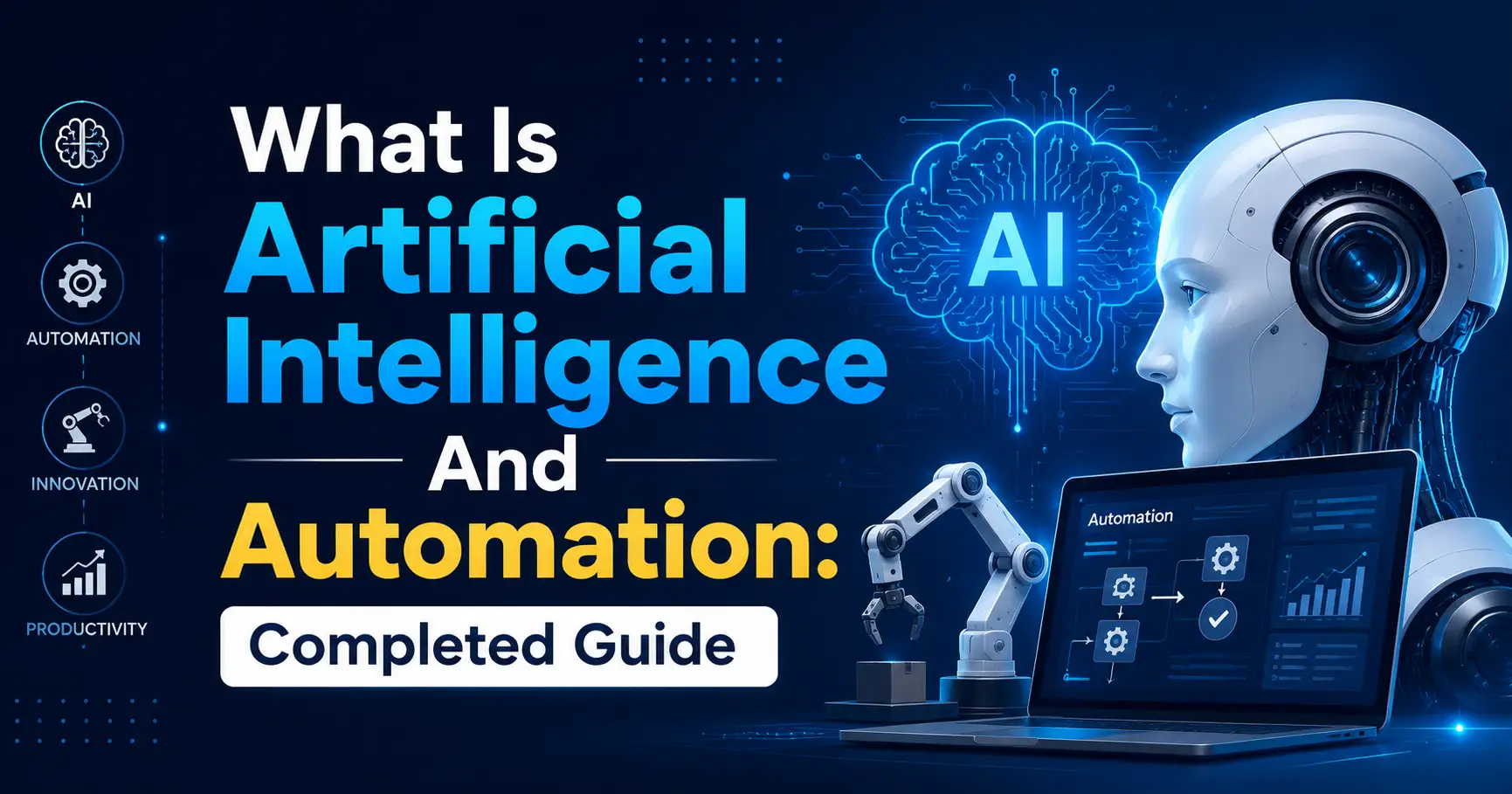


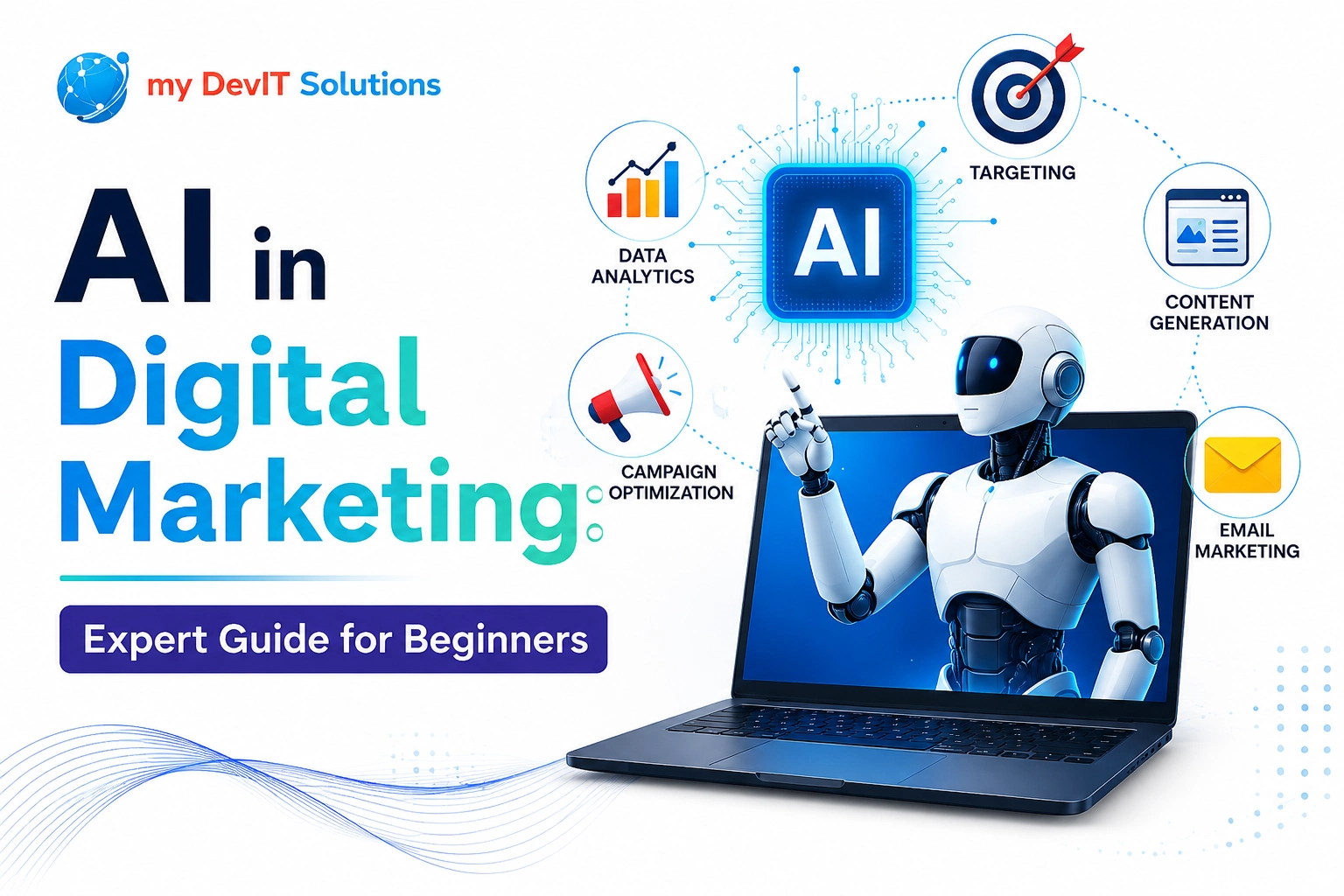
If you’ve scrolled through your feed today, chances are an algorithm already decided what you’d see before you even opened the app. That’s AI in Digital Marketing at work quietly, constantly, and increasingly at the center of how brands find, understand, and sell to customers. This guide, put together by the team at my DevIT Solutions, is written for one purpose only: to help you genuinely understand what AI in digital marketing is, how it actually works, and how to think about using it without hype, jargon, or oversimplified claims.
By the end of this article, you should be able to explain AI in digital marketing to someone else, know which tools solve which problems, understand the real risks involved, and have a clear, practical starting point for your own marketing whether you’re a student, a marketer, a founder, or just curious.
What Is AI in Digital Marketing?
AI in digital marketing refers to the use of machine learning, natural language processing (NLP), computer vision, and predictive analytics to plan, execute, analyze, and optimize marketing activities. Instead of a person manually guessing which ad performs best or which subject line gets more opens, AI systems process huge volumes of behavioral data clicks, purchases, time spent, scroll depth, past responses and make or suggest decisions in near real time.
It helps to understand that “AI in digital marketing” isn’t one single technology. It’s a combination of several underlying techniques, each solving a different kind of problem:
| AI Technique | What It Does | Common Marketing Use |
|---|---|---|
| Machine Learning (ML) | Finds patterns in historical data to predict future outcomes | Predicting which leads are likely to convert |
| Natural Language Processing (NLP) | Understands and generates human language | Chatbots, content generation, sentiment analysis |
| Computer Vision | Interprets images and video | Visual search, ad creative analysis |
| Predictive Analytics | Forecasts future behavior from past patterns | Churn prediction, demand forecasting |
| Generative AI | Creates new text, images, or audio | Blog drafts, ad copy, product images |
Understanding this distinction matters because when someone says “we use AI,” they could mean any one (or several) of these techniques — and each comes with different strengths, limitations, and data requirements.
How AI in Digital Marketing Actually Works
At a basic level, most AI marketing systems follow a repeatable cycle:
- Data collection:- the system gathers data from websites, apps, ad platforms, CRM systems, and customer interactions.
- Pattern recognition:- machine learning models analyze this data to find correlations (for example, which types of visitors tend to buy).
- Prediction or generation:- the model either predicts an outcome (like “this user is 80% likely to click”) or generates new content (like an ad headline).
- Action:- the marketing platform automatically acts on this prediction, such as adjusting a bid, sending a personalized email, or showing a specific product.
- Feedback loop:- the results of that action feed back into the system, so future predictions keep improving.
This cycle is why AI-driven marketing tends to get more accurate the longer it runs assuming the underlying data is clean and the goals are set correctly. It also explains why AI performs poorly when a business has little data, messy data, or unclear objectives; the system simply has nothing meaningful to learn from.
Why AI in Digital Marketing Matters Right Now
The shift from “experimenting with AI” to “depending on AI” has already happened across the marketing industry. Teams that once treated AI as an optional add-on now build entire workflows around it from content drafting to ad bidding to customer segmentation. Search behavior itself has changed too: AI-generated summaries now appear on a large share of search results, which means visibility isn’t just about ranking a page anymore it’s also about being accurate, well-structured, and quotable enough for an AI system to reference.
Here’s a snapshot of how widely AI in digital marketing has been adopted, based on recent industry research from 2026:
| Metric | Reported Figure | Why It Matters |
|---|---|---|
| Small & medium businesses using AI in marketing | Roughly two-thirds | AI is no longer just for large enterprises |
| Marketers using AI tools on a daily basis | Majority of surveyed marketers | Daily use signals AI is core to workflows, not occasional |
| Businesses reporting AI-driven cost savings | Majority of surveyed marketers | Direct, measurable impact on marketing budgets |
| Reduction in wasted ad spend from AI-driven bidding | Roughly one-third | Meaningfully better return on paid campaigns |
| Increase in monthly content output for AI-using teams | Notably higher than non-AI teams | Faster production without proportionally more staff |
| Marketers citing a skills gap as their top AI challenge | Majority | Adoption is outpacing training and understanding |
Figures are rounded industry averages compiled from multiple 2026 marketing research reports and are meant as directional benchmarks actual results vary by industry, business size, and how well AI is implemented.
That last row is worth sitting with for a moment. Most organizations aren’t struggling because AI tools don’t work they’re struggling because teams don’t fully understand how to use them well yet. That’s exactly the gap this guide is trying to close.
Key Applications of AI in Digital Marketing
AI touches almost every corner of a modern marketing strategy. Understanding each application individually makes it much easier to decide where to focus first.
AI for Content Creation
Generative AI tools can draft blog outlines, social captions, product descriptions, and ad copy in seconds. This doesn’t replace a writer’s judgment or subject-matter knowledge — it removes the blank-page problem and speeds up production. Many teams also use AI to repurpose one piece of long-form content into multiple formats: a webinar becomes a blog article, a blog article becomes five social posts, and so on. The important caveat is that AI-generated drafts still need fact-checking, tone adjustment, and a human editorial pass before publishing, since AI models can confidently state incorrect information.
AI for SEO and Search Visibility
Search itself has fundamentally changed, and understanding How SEO Is Affected By AI is now essential for anyone creating online content. Search engines increasingly generate summarized answers directly on the results page instead of only listing links, which means content needs to be structured clearly, backed by verifiable data, and written to directly answer specific user questions rather than being stuffed with keywords. AI tools also help with keyword clustering, content gap analysis, competitor research, and technical audits that used to take hours to do manually identifying broken links, slow pages, or missing metadata in minutes.
AI for Personalization
AI-driven personalization uses browsing history, purchase behavior, device type, location, and real-time signals to tailor what a visitor sees product suggestions, homepage banners, or email content. Customers increasingly expect this level of relevance; research shows a large majority of consumers now expect personalized interactions, and a significant share report frustration when brands fail to deliver them. The technical foundation for this kind of personalization usually depends on solid Website Design & Development Business Intelligence meaning a site’s data structure and analytics setup need to be strong enough for AI systems to actually have something useful to personalize with.
AI for Paid Advertising (PPC)
Platforms like Google and Meta now run most bidding decisions through AI systems such as automated bidding and performance-based campaign optimization. These systems test dozens of creative variations, adjust budgets in real time based on predicted intent, and target audiences using behavioral signals rather than static demographics alone. Reported figures suggest AI-driven bid management can meaningfully reduce wasted ad spend while improving overall return on ad spend, though results depend heavily on how well campaigns are structured to begin with.
AI Chatbots and Customer Support
Conversational AI now handles a large share of first-touch customer interactions answering frequently asked questions, qualifying leads, and routing complex issues to human agents. This keeps response times low around the clock, which matters because customer expectations for fast replies have risen sharply. The best implementations use AI for the repetitive 80% of queries while making it easy and fast to reach a human for anything nuanced or sensitive.
AI for Analytics and Attribution
One of the less visible but most valuable uses of AI in digital marketing is in analytics. Traditional attribution models often oversimplify the customer journey, crediting a single touchpoint (like the last click) for a conversion. AI-driven attribution instead analyzes the full path a customer takes across channels social, search, email, and direct and distributes credit more accurately, which leads to smarter budget decisions across the entire marketing mix.
AI in Digital Marketing for Startups and Small Businesses
One of the most common misconceptions is that AI in digital marketing is only useful for large enterprises with big budgets. In reality, a wide range of AI marketing tools are affordable or even free at entry level, and for early-stage companies, they can meaningfully narrow the gap against bigger, better-funded competitors. This is a major reason Digital Marketing Services For Startups increasingly center around AI-assisted workflows because they let small teams produce, test, and optimize at a pace that would otherwise require a much larger staff.
Here’s a simple breakdown of where startups typically start, and roughly what kind of budget commitment each area usually needs:
| Startup Priority | AI Tool Category | Typical Use Case | Relative Budget Needed |
|---|---|---|---|
| Content production | AI writing assistants | Blog drafts, ad copy, product descriptions | Low |
| Social media management | AI scheduling & caption tools | Consistent posting without a full-time team | Low |
| Customer support | AI chatbots | Handling FAQs and lead capture 24/7 | Low to Medium |
| Email marketing | AI send-time & subject line optimization | Higher open and click-through rates | Low |
| SEO research | AI keyword & content gap tools | Faster, data-backed content planning | Low to Medium |
| Paid advertising | AI-driven bidding platforms | Automated bid and budget optimization | Medium |
For most startups, the smartest approach is starting small picking one or two high-impact areas (usually content and customer support) rather than trying to automate everything at once. Spreading a limited budget across too many AI tools at once often means none of them are used well enough to show real results.
Benefits and Challenges of AI in Digital Marketing
Like any powerful tool, AI in digital marketing comes with real upside and real risk. Being honest about both is part of using it responsibly and understanding the risks is just as important as understanding the benefits.
| Benefits | Challenges |
|---|---|
| Faster content and campaign production | Risk of generic, low-quality output without human review |
| Lower cost-per-result on paid ad campaigns | Requires clean, sufficient data to work well |
| 24/7 customer engagement via chatbots | Data privacy and regulatory compliance concerns |
| Deeper personalization at scale | Learning curve and skills gap within teams |
| Real-time performance optimization | Can misread cultural, emotional, or ethical context |
| Frees staff time for strategic, creative work | Over-reliance can lead to brand voice becoming generic |
A well-documented cautionary example illustrates this last point clearly: a global brand once let an AI system auto-schedule a multi-country email campaign based purely on historical engagement data. The campaign performed as expected in most markets but in one region, it was unknowingly scheduled during a national day of mourning, an event the AI’s training data simply had no context for. Open rates in that market dropped sharply, and brand sentiment took a real hit. The lesson for beginners is straightforward: AI is excellent at recognizing patterns within the data it has, but it cannot reason about unstructured, real-world context the way a human can. That’s exactly why human oversight remains essential, not optional.
Common Mistakes Beginners Make with AI in Digital Marketing
Understanding what typically goes wrong helps avoid repeating the same errors:
- Publishing AI content without fact-checking. AI models can generate confident-sounding but incorrect statistics, dates, or claims.
- Feeding AI messy or incomplete data. Predictions and personalization are only as good as the data behind them.
- Automating everything at once. Trying to implement AI across every channel simultaneously usually leads to shallow, poorly monitored results.
- Ignoring data privacy regulations. Using customer data for AI-driven personalization without proper consent or transparency creates legal and trust risks.
- Treating AI output as final. The best results come from AI drafting and humans refining — not the reverse.
- Not tracking the right metrics. Focusing on output volume (like number of posts) instead of outcomes (like conversion rate or cost-per-lead).
How to Get Started with AI in Digital Marketing: A Step-by-Step Guide
- Audit your current marketing workflow:- Identify repetitive, time-consuming tasks these are your best starting points for AI.
- Pick one channel first:- Don’t try to automate everything at once. Start with content, email, or customer support.
- Choose tools that integrate with what you already use:- Compatibility with your existing website and CRM matters more than flashy features.
- Keep a human in the loop:- Every AI-generated output — content, ad copy, or chatbot script — should be reviewed before it goes live.
- Track real metrics, not vanity numbers:- Watch conversion rate, cost-per-lead, and engagement quality, not just output volume.
- Set clear data privacy boundaries:- Be transparent with customers about what data is collected and how it’s used for personalization.
- Scale gradually:- Once a workflow proves measurable ROI, expand AI into adjacent areas like SEO, paid ads, or deeper personalization.
A strong website is the foundation all of this sits on. AI-driven personalization, chatbots, and analytics can only perform as well as the site’s technical setup allows, which is why concepts like Trusted Web Application & Development Services in USA are closely tied to marketing performance a fast, well-structured, secure site gives AI tools accurate data to work with in the first place.
Metrics That Actually Matter When Using AI in Digital Marketing
Beginners often measure the wrong things when evaluating whether AI is “working.” Here’s a more useful framework:
| Metric Category | What to Track | Why It’s More Useful Than Vanity Metrics |
|---|---|---|
| Efficiency | Time saved per task, cost-per-lead | Shows real productivity and cost impact |
| Quality | Conversion rate, engagement rate | Shows whether AI output actually resonates |
| Accuracy | Prediction accuracy, personalization relevance | Shows how well the AI understands your audience |
| Trust | Bounce rate on AI-personalized pages, chatbot resolution rate | Shows whether AI interactions build or erode trust |
| Growth | Organic traffic, AI-search citation rate | Shows visibility in both traditional and AI-driven search |
Tracking these consistently, rather than just “how much content did we publish,” gives a far more honest picture of whether AI is actually improving marketing outcomes.
Data Privacy and Ethics in AI-Driven Marketing
Because AI in digital marketing depends heavily on customer data, ethical use isn’t optional it directly affects trust, legal compliance, and long-term brand reputation. A few principles worth understanding:
- Transparency:- Customers should reasonably understand when they’re interacting with an AI system (like a chatbot) rather than a human.
- Consent:- Data used for personalization or targeting should be collected with clear, informed consent, in line with applicable privacy regulations.
- Bias awareness:- AI models trained on historical data can unintentionally replicate biases present in that data, which can affect targeting fairness.
- Data minimization:- Collecting only the data actually needed for a specific purpose reduces both privacy risk and system complexity.
Marketers who build these principles into their AI workflows from the start tend to face far fewer trust and compliance issues later.
Website Strategy and AI: Why the Two Are Inseparable
AI in digital marketing doesn’t work in isolation it depends entirely on a strong website foundation. A slow, poorly structured site will underperform no matter how sophisticated the AI-driven campaigns pointing to it are, because AI can only optimize what the underlying infrastructure allows. This is closely connected to what’s often described as the Best Website Design Development and SEO Services in USA since AI-driven search results increasingly reward sites that are technically sound, fast-loading, mobile-friendly, and genuinely useful to visitors, not just keyword-optimized on the surface.
In practice, this means marketing teams and web development teams can no longer work in silos. Site speed, structured data, mobile experience, and content clarity all directly influence how well both AI marketing tools and AI-driven search engines can understand and promote a website.
The Future of AI in Digital Marketing
Looking ahead, a few shifts are already becoming visible in 2026:
- AI agents are moving from answering questions to taking actions:- Comparing options, booking, and even completing purchases on a customer’s behalf, which is starting to create a category of “machine customers.”
- Answer-engine visibility:- (Being cited inside AI-generated summaries on platforms like Google’s AI Overviews or AI chat tools) is becoming as important as traditional search rankings, since a growing share of queries never result in a traditional click at all.
- Voice and conversational search:- Continue to grow, changing how content needs to be structured shorter, clearer, more directly conversational.
- Predictive analytics:- Is shifting marketing from reactive monthly reporting to a continuous, real-time feedback loop that adjusts campaigns as they run.
- Multimodal AI:- Systems that understand text, image, and video together is starting to influence how ad creative and product content get generated and tested.
None of this means marketers become obsolete. It means the role is shifting from executing repetitive tasks to directing strategy, creativity, data interpretation, and ethical oversight while AI handles the heavy data lifting underneath.
Conclusion
AI in digital marketing isn’t a passing trend it’s quickly becoming the operating layer behind modern marketing, from content creation and SEO to paid advertising, personalization, and customer support. For beginners, the goal isn’t to adopt everything at once; it’s to understand how each piece actually works, where it genuinely helps, where it can go wrong, and how to keep human judgment firmly in the loop. Approached this way, AI stops being an intimidating buzzword and becomes what it’s actually meant to be: a practical tool that makes marketing faster, more personalized, and more data-informed without losing the human thinking that makes marketing effective in the first place. This guide was put together by my DevIT Solutions as a resource for anyone trying to genuinely understand this shift, not just keep up with it.
FAQs
A: It’s the use of machine learning, NLP, and automation to make marketing decisions like targeting, content, and ad bidding faster and more data-driven.
A: No, AI handles repetitive and data-heavy tasks well, but strategy, creativity, ethics, and cultural context still require human judgment.
A: Content creation, SEO research, ad bidding, personalization, customer support chatbots, and multi-touch attribution benefit the most.
A: Yes, AI-generated search summaries mean content must be clear, well-structured, fact-based, and written to directly answer user questions.
A: Publishing AI output without human review, which can lead to factual errors, generic content, or contextually inappropriate messaging.
A: Traditional automation follows fixed rules, while AI learns from data and adjusts its decisions over time based on results